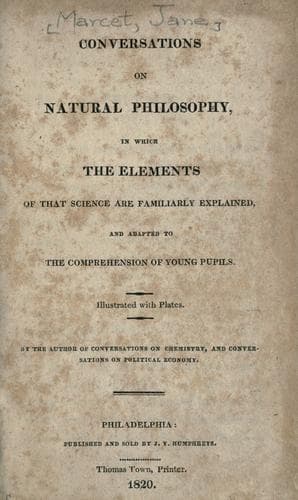
Conversations on Natural Philosophy, in which the Elements of that Science are Familiarly ExplainedMarcet, Mrs. (Jane Haldimand)
Science
Conversations on Natural Philosophy, in which the Elements of that Science are Familiarly Explained
Marcet, Mrs. (Jane Haldimand)
Physics
_Emily._ I should have supposed the contrary; for as the light reflected
from surrounding objects on the shadow, must be in proportion to the
intensity of the light, the stronger the light, the more the shadow will
be illumined.
_Mrs. B._ Your remark is perfectly just; but as we have no means of
estimating the degrees of light, and of darkness, but by comparison, the
strongest light will appear to produce the deepest shadow. Hence a total
eclipse of the sun, occasions a more sensible darkness than midnight, as
it is immediately contrasted with the strong light of noonday.
_Caroline._ The reappearance of the sun, after an eclipse, must, by the
same contrast, appear remarkably brilliant.
_Mrs. B._ Certainly. There are several things to be observed, in regard
to the form, and extent, of shadows. If the luminous body A (fig. 3.) is
larger than the opaque body B, the shadow will gradually diminish in
size, till it terminates in a point.
_Caroline._ This is the case with the shadows of the earth, and the
moon; as the sun, which illumines them, is larger than either of those
bodies. And why is it not the case with the shadows of terrestrial
objects? Their shadows, far from diminishing, are always larger than the
object, and increase with the distance from it.
_Mrs. B._ In estimating the effect of shadows, we must consider the
dimensions of the luminous body; when the luminous body is less, than
the opaque body, the shadow will increase with the distance. This will
be best exemplified, by observing the shadow of an object lighted by a
candle.
_Emily._ I have often noticed, that the shadow of my figure, against the
wall, grows larger, as it is more distant from me, which is owing, no
doubt, to the candle that shines on me, being much smaller than myself.
_Mrs. B._ Yes. The shadow of a figure as A, (fig. 4.) varies in size,
according to the distance of the several surfaces B C D E, on which it
is described.
_Caroline._ I have observed, that two candles, produce two shadows from
the same object; whilst it would appear, from what you said, that they
should rather produce only half a shadow, that is to say, a very faint
one.
_Mrs. B._ The number of lights (in different directions) while it
decreases the intensity of the shadows, increases their number, which
always corresponds with that of the lights; for each light, makes the
opaque body cast a different shadow, as illustrated by fig. 5. which
represents a ball A, lighted by three candles, B, C, D; and you observe
the light B, produces the shadow _b_, the light C, the shadow _c_, and
the light D, the shadow _d_; but neither of these shadows will be very
dark, because the light of one candle only, is intercepted by the ball;
and the spot is still illuminated by the other two.
_Emily._ I think we now understand the nature of shadows very well; but
pray, what becomes of the rays of light, which opaque bodies arrest in
their course, and the interruption of which, is the occasion of shadows?
Public-domain text, read in full here on John Shaqi.
Reviews
Reviews
No reviews yet
Be the first to share your thoughts on this work.
Elsewhere in the archive
Join the Discussion
Join the discussion
Sign in to leave a comment or review.
Sign InorCreate an account