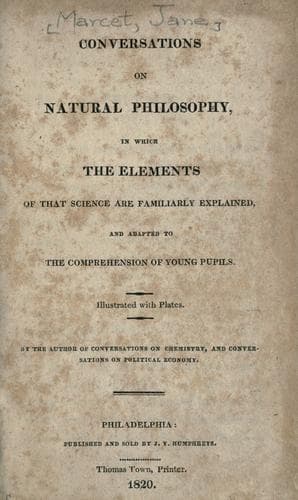
Conversations on Natural Philosophy, in which the Elements of that Science are Familiarly ExplainedMarcet, Mrs. (Jane Haldimand)
Science
Conversations on Natural Philosophy, in which the Elements of that Science are Familiarly Explained
Marcet, Mrs. (Jane Haldimand)
Physics
_Mrs. B._ Your question leads to a very important property of light,
_Reflection_. When rays of light encounter an opaque body, they cannot
pass through it, and part of them are absorbed by it, and part are
reflected, and rebound; just as an elastic ball rebounds, when struck
against a wall.
By reflection, we mean that the light is turned back again, through the
same medium which it had traversed in its first course.
_Emily._ And is light, in its reflection, governed by the same laws, as
solid, elastic bodies?
_Mrs. B._ Exactly. If a ray of light fall perpendicularly on an opaque
body, it is reflected back in the same line, towards the point whence it
proceeded. If it fall obliquely, it is reflected obliquely, but in the
opposite direction; the ray which falls upon the reflecting surface, is
called the incident ray, and that which leaves it, the reflected ray;
the angle of incidence, is always equal to the angle of reflection. You
recollect that law in mechanics?
_Emily._ Oh yes, perfectly.
_Mrs. B._ If you will shut the shutters, we will admit a ray of the
sun's light, through a very small aperture, and I can show you how it is
reflected. I now hold this mirror, so that the ray shall fall
perpendicularly upon it.
_Caroline._ I see the ray which falls upon the mirror, but not that
which is reflected by it.
_Mrs. B._ Because it is turned directly back again; and the ray of
incidence, and that of reflection, are confounded together, both being
in the same line, though in opposite directions.
_Emily._ The ray then, which appears to us single, is really double, and
is composed of the incident ray, proceeding to the mirror, and of the
reflected ray, returning from the mirror.
_Mrs. B._ Exactly so. We will now separate them, by holding the mirror
M, (fig. 6,) in such a manner, that the incident ray, A B, shall fall
obliquely upon it--you see the reflected ray, B C, is marching off in
another direction. If we draw a line from the point of incidence B,
perpendicularly, to the mirror, it will divide the angle of incidence,
from the angle of reflection, and you will see that they are equal.
_Emily._ Exactly; and now, that you hold the mirror, so that the ray
falls more obliquely upon it, it is also reflected more obliquely,
preserving the equality of the angles of incidence, and of reflection.
_Mrs. B._ It is by reflected rays only, that we see opaque objects.
Luminous bodies, send rays of light immediately to our eyes, but the
rays which they send to other bodies, are invisible to us, and are seen,
only when they are reflected by those bodies, to our eyes.
_Emily._ But have we not just seen the ray of light, in its passage from
the sun to the mirror, and its reflections? yet, in neither case, were
those rays in a direction to enter our eyes.
_Mrs. B._ What you saw, was the light reflected to your eyes, by small
particles of dust floating in the air, and on which the ray shone, in
its passage to, and from, the mirror.
Public-domain text, read in full here on John Shaqi.
Reviews
Reviews
No reviews yet
Be the first to share your thoughts on this work.
Elsewhere in the archive
Join the Discussion
Join the discussion
Sign in to leave a comment or review.
Sign InorCreate an account