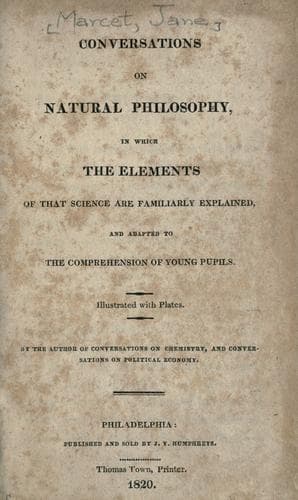
Conversations on Natural Philosophy, in which the Elements of that Science are Familiarly ExplainedMarcet, Mrs. (Jane Haldimand)
Science
Conversations on Natural Philosophy, in which the Elements of that Science are Familiarly Explained
Marcet, Mrs. (Jane Haldimand)
Physics
_Caroline._ Yet I see the sun, shining on that house yonder, as clearly
as possible.
_Mrs. B._ Indeed you cannot see a single ray, which passes from the sun
to the house; you see, by the aid of those rays, which enter your eyes;
therefore, it is the rays which are reflected by the house, to you, and
not those which proceed directly from the sun, to the house, that render
the building visible to you.
_Caroline._ Why then does one side of the house appear to be in
sunshine, and the other in shade? for, if I cannot see the sun shine
upon it, the whole of the house should appear in the shade.
_Mrs. B._ That side of the house, which the sun shines upon, receives,
and reflects more light, and therefore, appears more luminous and vivid,
than the side which is in shadow; for the latter is illumined only, by
rays reflected upon it by other objects; these rays are, therefore,
twice reflected before they reach your sight; and as light is more, or
less, absorbed by the bodies it strikes upon, every time a ray is
reflected, its intensity is diminished.
_Caroline._ Still I cannot reconcile to myself, the idea that we do not
see the sun's rays shining on objects, but only those which such objects
reflect to us.
_Mrs. B._ I do not, however, despair of convincing you of it. Look at
that large sheet of water; can you tell why the sun appears to shine on
one part of it only?
_Caroline._ No, indeed; for the whole of it is equally exposed to the
sun. This partial brilliancy of water, has often excited my wonder; but
it has struck me more particularly by moonlight. I have frequently
observed a vivid streak of moonshine on the sea, while the rest of the
water remained in deep obscurity, and yet there was no apparent obstacle
to prevent the moon from shining equally on every part of the water.
_Mrs. B._ By moonlight the effect is more remarkable, on account of the
deep obscurity of the other parts of the water; while by the sun's
light, the effect is too strong for the eye to be able to observe it so
distinctly.
_Caroline._ But, if the sun really shines on every part of that sheet of
water, why does not every part of it, reflect rays to my eyes?
_Mrs. B._ The reflected rays, are not attracted out of their natural
course, by your eyes. The direction of a reflected ray, you know,
depends on that of the incident ray; the sun's rays, therefore, which
fall with various degrees of obliquity upon the water, are reflected in
directions equally various; some of these will meet your eyes, and you
will see them, but those which fall elsewhere, are invisible to you.
_Caroline._ The streak of sunshine, then, which we now see upon the
water, is composed of those rays which by their reflection, happen to
fall upon my eyes?
_Mrs. B._ Precisely.
_Emily._ But is that side of the house yonder, which appears to be in
shadow, really illuminated by the sun, and its rays reflected another
way?
Public-domain text, read in full here on John Shaqi.
Reviews
Reviews
No reviews yet
Be the first to share your thoughts on this work.
Elsewhere in the archive
Join the Discussion
Join the discussion
Sign in to leave a comment or review.
Sign InorCreate an account