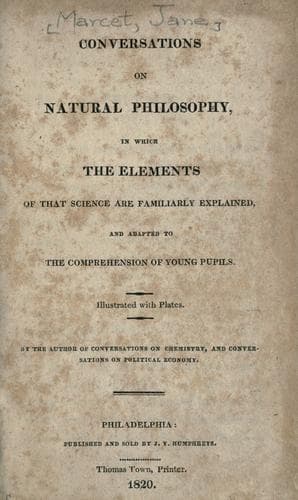
Conversations on Natural Philosophy, in which the Elements of that Science are Familiarly ExplainedMarcet, Mrs. (Jane Haldimand)
Science
Conversations on Natural Philosophy, in which the Elements of that Science are Familiarly Explained
Marcet, Mrs. (Jane Haldimand)
Physics
_Mrs. B._ No; that is a different case, from the sheet of water. That
side of the house, is really in shadow; it is the west side, which the
sun cannot shine upon, till the afternoon.
_Emily._ Those objects, then, which are illumined by reflected rays, and
those which receive direct rays from the sun, but which do not reflect
those rays towards us, appear equally in shadow?
_Mrs. B._ Certainly; for we see them both illumined by reflected rays.
That part of the sheet of water, over which the trees cast a shadow, by
what light do you see it?
_Emily._ Since it is not by the sun's direct rays, it must be by those
reflected on it from other objects, and which it again reflects to us.
_Caroline._ But if we see all terrestrial objects by reflected light,
(as we do the moon,) why do they appear so bright and luminous? I should
have supposed that reflected rays, would have been dull and faint, like
those of the moon.
_Mrs. B._ The moon reflects the sun's light, with as much vividness as
any terrestrial object. If you look at it on a clear night, it will
appear as bright as a sheet of water, the walls of a house, or any
object seen by daylight, and on which the sun shines. The rays of the
moon are doubtless feeble, when compared with those of the sun; but that
would not be a fair comparison, for the former are incident, the latter,
reflected rays.
_Caroline._ True; and when we see terrestrial objects by moonlight, the
light has been twice reflected, and is consequently, proportionally
fainter.
_Mrs. B._ In traversing the atmosphere, the rays, both of the sun, and
moon, lose some of their light. For though the pure air, is a
transparent medium, which transmits the rays of light freely, we have
observed, that near the surface of the earth, it is loaded with vapours
and exhalations, by which some portion of them are absorbed.
_Caroline._ I have often noticed, that an object on the summit of a
hill, appears more distinct, than one at an equal distance in a valley,
or a plain; which is owing, I suppose, to the air being more free from
vapours in an elevated situation, and the reflected rays, being
consequently brighter.
_Mrs. B._ That may have some sensible effect; but, when an object on the
summit of a hill, has a back ground of light sky, the contrast with the
object, makes its outline more distinct.
_Caroline._ I now feel well satisfied, that we see opaque objects, only
by reflected rays; but I do not understand, how these rays, show us the
objects from which they proceed.
Public-domain text, read in full here on John Shaqi.
Reviews
Reviews
No reviews yet
Be the first to share your thoughts on this work.
Elsewhere in the archive
Join the Discussion
Join the discussion
Sign in to leave a comment or review.
Sign InorCreate an account