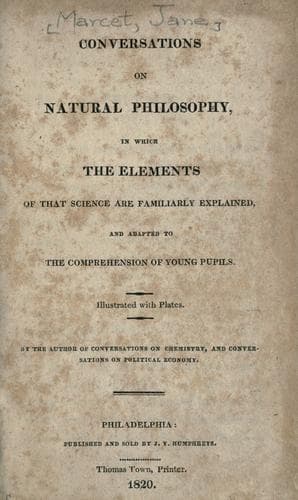
Conversations on Natural Philosophy, in which the Elements of that Science are Familiarly ExplainedMarcet, Mrs. (Jane Haldimand)
Science
Conversations on Natural Philosophy, in which the Elements of that Science are Familiarly Explained
Marcet, Mrs. (Jane Haldimand)
Physics
_Mrs. B._ I shall hereafter describe the structure of the eye, very
particularly, but will now observe, that the small round spot, which is
generally called the sight of the eye, is properly denominated the
_pupil_; and that the _retina_, is an expansion of the optic nerve on
the back part of the ball of the eye, upon which, as upon a screen, the
rays fall, which enter at the pupil. The rays of light, enter at the
pupil of the eye, and proceed to the retina; and there they describe the
figure, colour, and (excepting size) form a perfect representation of
the object, from which they proceed. We shall again close the shutters,
and admit the light, through the small hole made for that purpose, and
you will see a picture, on the wall, opposite the aperture, similar to
that which is delineated on the retina of the eye. The picture is
somewhat confused, but by using a lens, to bring the rays to a focus, it
will be rendered very distinct.
_Caroline._ Oh, how wonderful! There is an exact picture in miniature of
the garden, the gardener at work, the trees blown about by the wind. The
landscape, would be perfect, if it were not reversed; the ground, being
above, and the sky beneath.
_Mrs. B._ It is not enough to admire, you must understand, this
phenomenon, which is called a _camera obscura_, or dark chamber; from
the necessity of darkening the room, in order to exhibit it. The camera
obscura, sometimes consists of a small box, properly fitted up, to
represent external objects.
This picture, you now see, is produced by the rays of light, reflected
from the various objects in the garden, and which are admitted through
the hole in the window shutter.
[Illustration: PLATE XVI.]
The rays from the glittering weathercock, at the top of the alcove, A,
(plate 16.) represent it in this spot, _a_; for the weathercock, being
much higher than the aperture in the shutter, only a few of the rays,
which are reflected by it, in an obliquely descending direction, can
find entrance there. The rays of light, you know, always move in
straight lines; those, therefore, which enter the room, in a descending
direction, will continue their course in the same direction, and will
consequently fall upon the lower part of the wall opposite the aperture,
and represent the weathercock, reversed in that spot, instead of erect,
in the uppermost part of the landscape.
_Emily._ And the rays of light, from the steps, (B) of the alcove, in
entering the aperture, ascend, and will describe those steps in the
highest, instead of the lowest, part of the landscape.
Public-domain text, read in full here on John Shaqi.
Reviews
Reviews
No reviews yet
Be the first to share your thoughts on this work.
Elsewhere in the archive
Join the Discussion
Join the discussion
Sign in to leave a comment or review.
Sign InorCreate an account