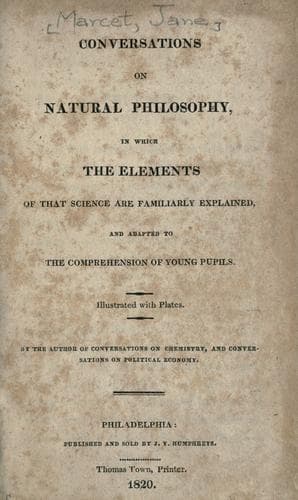
Conversations on Natural Philosophy, in which the Elements of that Science are Familiarly ExplainedMarcet, Mrs. (Jane Haldimand)
Science
Conversations on Natural Philosophy, in which the Elements of that Science are Familiarly Explained
Marcet, Mrs. (Jane Haldimand)
Physics
_Mrs. B._ Observe, too, that the rays coming from the alcove, which is
to our left, describe it on the wall, to the right; while those, which
are reflected by the walnut tree, C D, to our right, delineate its
figure in the picture, to the left, _c d_. Thus the rays, coming in
different directions, and proceeding always in right lines, cross each
other at their entrance through the aperture; those which come from
above, proceed below, those from the right, go to the left, those from
the left, towards the right; thus every object is represented in the
picture, as occupying a situation, the very reverse of that which it
does in nature.
_Caroline._ Excepting the flower-pot, E F, which, though its position is
reversed, has not changed its situation in the landscape.
_Mrs. B._ The flower-pot, is directly in front of the aperture; so that
its rays, fall perpendicularly upon it, and consequently proceed
perpendicularly to the wall, where they delineate the object, directly
behind the aperture.
_Emily._ And is it thus, that the picture of objects, is painted on the
retina of the eye?
_Mrs. B._ Precisely. The pupil of the eye, through which the rays of
light enter, represents the aperture in the window-shutter; and the
image, delineated on the retina, is exactly similar to the picture on
the wall.
_Caroline._ You do not mean to say, that we see only the representation
of the object, which is painted on the retina, and not the object
itself?
_Mrs. B._ If, by sight, you understand that sense, by which the presence
of objects is perceived by the mind, through the means of the eyes, we
certainly see only the image of those objects, painted on the retina.
_Caroline._ This appears to me quite incredible.
_Mrs. B._ The nerves, are the only part of our frame, capable of
sensation: they appear, therefore, to be the instruments, which the mind
employs in its perceptions; for a sensation, always conveys an idea, to
the mind. Now it is known, that our nerves can be affected only by
contact; and for this reason, the organs of sense, cannot act at a
distance: for instance, we are capable of smelling only particles which
are actually in contact with the nerves of the nose. We have already
observed, that the odour of a flower consists in effluvia, composed of
very minute particles, which penetrate the nostrils, and strike upon the
olfactory nerves, which instantly convey the idea of odour to the mind.
_Emily._ And sound, though it is said to be heard at a distance, is, in
fact, heard only when the vibrations of the air, which convey it to our
ears, strike upon the auditory nerve.
_Caroline._ There is no explanation required, to prove that the senses
of feeling and of tasting, are excited only by contact.
Public-domain text, read in full here on John Shaqi.
Reviews
Reviews
No reviews yet
Be the first to share your thoughts on this work.
Elsewhere in the archive
Join the Discussion
Join the discussion
Sign in to leave a comment or review.
Sign InorCreate an account