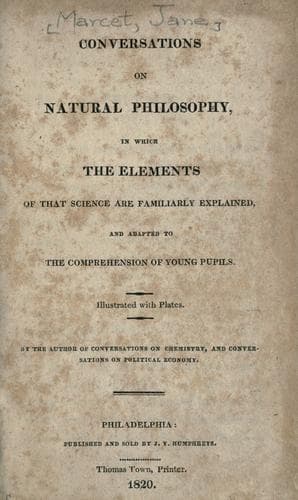
Conversations on Natural Philosophy, in which the Elements of that Science are Familiarly ExplainedMarcet, Mrs. (Jane Haldimand)
Science
Conversations on Natural Philosophy, in which the Elements of that Science are Familiarly Explained
Marcet, Mrs. (Jane Haldimand)
Physics
_Caroline._ I now see a tree, the body of which, appears to be in a line
exactly opposite to one of the bars.
_Mrs. B._ If you now shut your right eye, and look with the left, it
will appear to the left of the bar; then by closing the left eye, and
looking with the other, it will appear to the right of the bar.
_Caroline._ That is true, indeed!
_Mrs. B._ There are, evidently, two representations of the tree in
different situations, which must be owing to an image of it being formed
on each eye; if the action of the rays, therefore, on each retina, were
not so perfectly similar as to produce but one sensation, we should see
double; and we find that to be the case with some persons, who are
afflicted with a disease in one eye, which prevents the rays of light
from affecting it in the same manner as the other.
_Emily._ Pray, Mrs. B., when we see the image of an object in a
looking-glass, why is it not inverted, as in the camera obscura, and on
the retina of the eye?
_Mrs. B._ Because the rays do not enter the mirror by a small aperture,
and cross each other, as they do at the orifice of a camera obscura, or
the pupil of the eye.
When you view yourself in a mirror, the rays from your eyes fall
perpendicularly upon it, and are reflected in the same line; the image
is, therefore, described behind the glass, and is situated in the same
manner as the object before it.
_Emily._ Yes, I see that it is; but the looking-glass is not nearly so
tall as I am, how is it, therefore, that I can see the whole of my
figure in it?
_Mrs. B._ It is not necessary that the mirror should be more than half
your height, in order that you may see the whole of your person in it,
(fig. 3.) The ray of light A B, from your eye, which falls
perpendicularly on the mirror B D, will be reflected back, in the same
line; but the ray from your feet, will fall obliquely on the mirror, for
it must ascend in order to reach it; it will, therefore, be reflected in
the line A D: and since we view objects in the direction of the
reflected rays, which reach the eye, and since the image appears at the
same distance, behind the mirror, that the object is before it, we must
continue the line A D to E, and the line C D to F, at the termination of
which, the image will be represented.
[Illustration: PLATE XVIII.]
_Emily._ Then I do not understand why I should not see the whole of my
person in a much smaller mirror, for a ray of light from my feet would
always reach it, though more obliquely.
_Mrs. B._ True; but the more obliquely the ray falls on the mirror, the
more obliquely it will be reflected; the ray would, therefore, be
reflected above your head, and you could not see it. This is shown by
the dotted line (fig. 3.)
Now stand a little to the right of the mirror, so that the rays of light
from your figure may fall obliquely on it----
_Emily._ There is no image formed of me in the glass now.
Public-domain text, read in full here on John Shaqi.
Reviews
Reviews
No reviews yet
Be the first to share your thoughts on this work.
Elsewhere in the archive
Join the Discussion
Join the discussion
Sign in to leave a comment or review.
Sign InorCreate an account