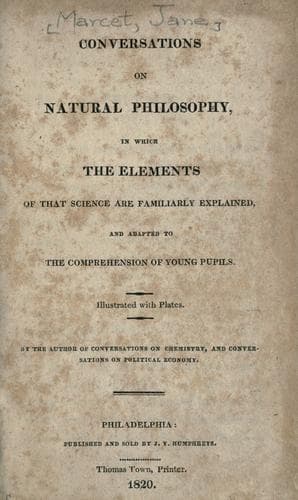
Conversations on Natural Philosophy, in which the Elements of that Science are Familiarly ExplainedMarcet, Mrs. (Jane Haldimand)
Science
Conversations on Natural Philosophy, in which the Elements of that Science are Familiarly Explained
Marcet, Mrs. (Jane Haldimand)
Physics
43. (Pg. 18) Give some familiar examples of capillary attraction.
44. (Pg. 18) In what does _gravitation_ differ from cohesive attraction?
45. (Pg. 18) What causes bodies near the earth's surface, to have a
tendency to fall towards it?
46. (Pg. 19) What remarkable difference is there between the attraction
of gravitation, and that of cohesion?
47. (Pg. 19) In what instances does the power of cohesion counteract
that of gravitation?
48. (Pg. 19) Why will water rise to a less height, if the size of the
tube is increased?
49. (Pg. 20) Why do not two bodies cohere, when laid upon each other?
50. (Pg. 20) Can two bodies be made sufficiently flat to cohere with
considerable force?
51. (Pg. 20) What is the reason that the adhesion is greater when oil is
interposed?
52. (Pg. 21) What other modifications of attraction are there, besides
those of cohesion and of gravitation?
CONVERSATION II.
ON THE ATTRACTION OF GRAVITY.
ATTRACTION OF GRAVITATION, CONTINUED. OF WEIGHT. OF THE FALL OF BODIES.
OF THE RESISTANCE OF THE AIR. OF THE ASCENT OF LIGHT BODIES.
EMILY.
I have related to my sister Caroline all that you have taught me of
natural philosophy, and she has been so much delighted by it, that she
hopes you will have the goodness to admit her to your lessons.
_Mrs. B._ Very willingly; but I did not think you had any taste for
studies of this nature, Caroline.
_Caroline._ I confess, Mrs. B., that hitherto I had formed no very
agreeable idea either of philosophy, or philosophers; but what Emily has
told me has excited my curiosity so much, that I shall be highly pleased
if you will allow me to become one of your pupils.
_Mrs. B._ I fear that I shall not find you so tractable a scholar as
Emily; I know that you are much biased in favour of your own opinions.
_Caroline._ Then you will have the greater merit in reforming them, Mrs.
B.; and after all the wonders that Emily has related to me, I think I
stand but little chance against you and your attractions.
_Mrs. B._ You will, I doubt not, advance a number of objections; but
these I shall willingly admit, as they will afford an opportunity of
elucidating the subject. Emily, do you recollect the names of the
general properties of bodies?
_Emily._ Impenetrability, extension, figure, divisibility, inertia and
attraction.
_Mrs. B._ Very well. You must remember that these are properties common
to all bodies, and of which they cannot be deprived; all other
properties of bodies are called accidental, because they depend on the
relation or connexion of one body to another.
_Caroline._ Yet surely, Mrs. B., there are other properties which are
essential to bodies, besides those you have enumerated. Colour and
weight, for instance, are common to all bodies, and do not arise from
their connexion with each other, but exist in the bodies themselves;
these, therefore, cannot be accidental qualities?
Public-domain text, read in full here on John Shaqi.
Reviews
Reviews
No reviews yet
Be the first to share your thoughts on this work.
Join the Discussion
Join the discussion
Sign in to leave a comment or review.
Sign InorCreate an account