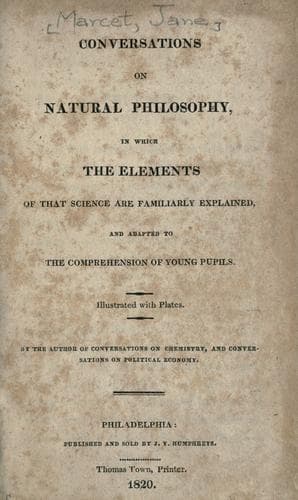
Conversations on Natural Philosophy, in which the Elements of that Science are Familiarly ExplainedMarcet, Mrs. (Jane Haldimand)
Science
Conversations on Natural Philosophy, in which the Elements of that Science are Familiarly Explained
Marcet, Mrs. (Jane Haldimand)
Physics
3. (Pg. 10) Name those properties of bodies, which are called inherent.
4. (Pg. 10) What is meant by impenetrability?
5. (Pg. 10) Can a liquid be said to be impenetrable?
6. (Pg. 11) How can you prove that air is impenetrable?
7. (Pg. 11) If air is impenetrable, what causes the water to rise some
way into a goblet, if I plunge it into water with its mouth downward?
8. (Pg. 11) When I drive a nail into wood, do not both the iron and the
wood occupy the same space?
9. (Pg. 11) In how many directions, is a body said to have extension?
10. (Pg. 11) How do we distinguish the terms height and depth?
11. (Pg. 12) What constitutes the _figure_, or _form_ of a body?
12. (Pg. 12) What is said respecting the form of minerals?
13. (Pg. 12) What of the vegetable and animal creation?
14. (Pg. 12) What of artificial, and accidental forms?
15. (Pg. 12) What is meant by divisibility?
16. (Pg. 12) What examples can you give, to prove that the particles of
a body are minute in the extreme?
17. (Pg. 13) What produces the odour of bodies?
18. (Pg. 13) How do odours exemplify the minuteness of the particles of
matter?
19. (Pg. 13) Can matter be in any way annihilated?
20. (Pg. 13) What becomes of the fuel, which disappears in our fires?
21. (Pg. 14) How can that part which evaporates, be still said to
possess a substantial form?
22. (Pg. 14) What do we mean by _inertia_?
23. (Pg. 14) Give an example to prove that force is necessary, either to
give or to stop motion.
24. (Pg. 14) What general power do the particles of matter exert upon
other particles?
25. (Pg. 15) What is that species of attraction called, which keeps
bodies in a solid state?
26. (Pg. 15) Does the attraction of cohesion exist in liquids, and how
is its existence proved?
27. (Pg. 15) If the particles of air attract each other, why do they not
cohere?
28. (Pg. 15) From what then do you infer that they possess attraction?
29. (Pg. 15) How do you account for some bodies being hard and others
soft?
30. (Pg. 16) What is meant by the term _density_?
31. (Pg. 16) Do the most dense bodies always cohere the most strongly?
32. (Pg. 16) How do we know that one body is more dense than another?
33. (Pg. 16) What is there which acts in opposition to cohesive
attraction, tending to separate the particles of bodies?
34. (Pg. 17) What would be the consequence if the repulsive power of
heat were not exerted?
35. (Pg. 17) If we continue to increase the heat, what effects will it
produce on bodies?
36. (Pg. 17) What body has its dimensions most sensibly affected by
change of temperature?
37. (Pg. 17) What power restores vapours to the liquid form?
38. (Pg. 17) What examples can you give?
39. (Pg. 17) How are drops of rain and of dew said to be formed?
40. (Pg. 18) What is meant by a capillary tube?
41. (Pg. 18) What effect does attraction produce when these are immersed
in water?
42. (Pg. 18) What is the reason that the water rises to a certain height
only?
Public-domain text, read in full here on John Shaqi.
Reviews
Reviews
No reviews yet
Be the first to share your thoughts on this work.
Join the Discussion
Join the discussion
Sign in to leave a comment or review.
Sign InorCreate an account