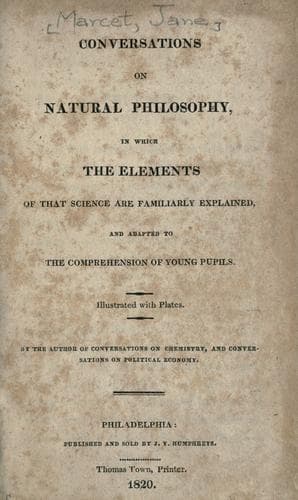
Conversations on Natural Philosophy, in which the Elements of that Science are Familiarly ExplainedMarcet, Mrs. (Jane Haldimand)
Science
Conversations on Natural Philosophy, in which the Elements of that Science are Familiarly Explained
Marcet, Mrs. (Jane Haldimand)
Physics
Of the three rays, A B C, which fall on the lens D E, the rays A and C
are refracted in their passage through it, to _a_, and _c_; and on
quitting the lens, they undergo a second refraction in the same
direction, which unites them with the ray B, at the focus F.
_Emily._ And what is the distance of the focus, from the surface of the
lens?
_Mrs. B._ The focal distance depends both upon the form of the lens, and
on the refracting power of the substance of which it is made: in a glass
lens, both sides of which are equally convex, the focus is situated
nearly at the centre of the sphere, of which the surface of the lens
forms a portion; it is at the distance, therefore, of the radius of the
sphere.
The property of those lenses which have a convex surface, is to collect
the rays of light to a focus; and of those which have a concave surface,
on the contrary, to disperse them. For the rays A and C, falling on the
concave lens X Y, (fig. 7, plate 19.) instead of converging towards the
ray B, in the axis of the lens, will each be attracted towards the thick
edges of the lens, both on entering and quitting it, and will,
therefore, by the first refraction, be made to diverge to _a_, _c_, and
by the seconds, to _d_, _e_.
[Illustration: PLATE XX.]
_Caroline._ And lenses which have one side flat, and the other
convex, or concave, as A and B, (fig. 1, plate 20.) are, I suppose,
less powerful in their refractions?
_Mrs. B._ Yes; the focus of the plano-convex, is at the distance of the
diameter of a sphere, of which the convex surface of the lens, forms a
portion; as represented in figure 2, plate 20. The three parallel rays,
A B C, are brought to a focus by the plano-convex lens, X Y, at F.
_Emily._ You have not explained to us, Mrs. B., how the lens serves to
magnify objects.
_Mrs. B._ By turning again to fig. 6, plate 19. you will readily
understand this. Let A C, be an object placed before the lens, and
suppose it to be seen by an eye at F; the ray from the point A, will be
seen in the direction F G, that from C, in the direction F H; the visual
angle, therefore, will be greatly increased, and the object must appear
larger, in proportion.
I must now explain to you the refraction of a ray of light, by a
triangular piece of glass, called a prism. (Fig. 3.)
_Emily._ The three sides of this glass are flat; it cannot, therefore,
bring the rays to a focus; nor do I suppose that its refraction will be
similar to that of a flat pane of glass, because it has not two sides
parallel; I cannot, therefore, conjecture what effect the refraction by
a prism, can produce.
_Mrs. B._ The refractions of the ray, both on entering and on quitting
the prism, are in the same direction, (Fig. 3.) On entering the prism P,
the ray A is refracted from B to C, and on quitting it from C to D. In
the first instance it is refracted towards, and in the last, from the
perpendicular; each causing it to deviate in the same way, from its
original course, A B.
Public-domain text, read in full here on John Shaqi.
Reviews
Reviews
No reviews yet
Be the first to share your thoughts on this work.
Elsewhere in the archive
Join the Discussion
Join the discussion
Sign in to leave a comment or review.
Sign InorCreate an account