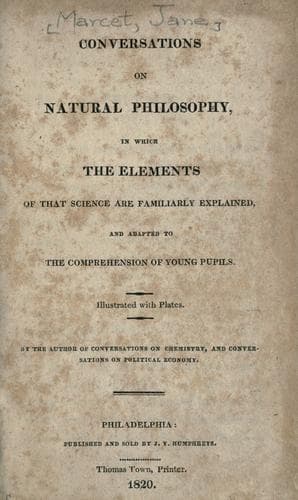
Conversations on Natural Philosophy, in which the Elements of that Science are Familiarly ExplainedMarcet, Mrs. (Jane Haldimand)
Science
Conversations on Natural Philosophy, in which the Elements of that Science are Familiarly Explained
Marcet, Mrs. (Jane Haldimand)
Physics
I will show you this by experiment; but for this purpose it will be
advisable to close the window-shutters, and admit, through the small
aperture, a ray of light, which I shall refract, by means of this prism.
_Caroline._ Oh, what beautiful colours are represented on the opposite
wall! There are all the colours of the rainbow, and with a brightness, I
never saw equalled. (Fig. 4, plate 20.)
_Emily._ I have seen an effect, in some respects similar to this,
produced by the rays of the sun shining upon glass lustres; but how is
it possible that a piece of white glass can produce such a variety of
brilliant colours?
_Mrs. B._ The colours are not formed by the prism, but existed in the
ray previously to its refraction.
_Caroline._ Yet, before its refraction, it appeared perfectly white.
_Mrs. B._ The white rays of the sun, are composed of rays, which, when
separated, produce all these colours, although when blended together,
they appear colourless or white.
Sir Isaac Newton, to whom we are indebted for the most important
discoveries respecting light and colours, was the first who divided a
white ray of light, and found it to consist of an assemblage of coloured
rays, which formed an image upon the wall, such as you now see
exhibited, (fig. 4.) in which are displayed the following series of
colours: red, orange, yellow, green, blue, indigo, and violet.
_Emily._ But how does a prism separate these coloured rays?
_Mrs. B._ By refraction. It appears that the coloured rays have
different degrees of refrangibility; in passing through the prism,
therefore, they take different directions according to their
susceptibility of refraction. The violet rays deviate most from their
original course; they appear at one of the ends of the spectrum, A B:
contiguous to the violet, are the blue rays, being those which have
somewhat less refrangibility; then follow, in succession, the green,
yellow, orange, and lastly, the red, which are the least refrangible of
the coloured rays.
_Caroline._ I cannot conceive how these colours, mixed together, can
become white?
_Mrs. B._ That I cannot pretend to explain: but it is a fact that the
union of these colours, in the proportions in which they appear in the
spectrum, produce in us the idea of whiteness. If you paint a circular
piece of card, in compartments, with these seven colours, as nearly as
possible in the proportion, and of the shade exhibited in the spectrum,
and whirl it rapidly on a pin, it will appear white; as the velocity of
the motion, will have the effect of blending the colours, in the
impression which they make upon the eye.
But a more decisive proof of the composition of a white ray is afforded,
by reuniting these coloured rays, and forming with them, a ray of white
light.
_Caroline._ If you can take a ray of white light to pieces, and put it
together again, I shall be quite satisfied.
Public-domain text, read in full here on John Shaqi.
Reviews
Reviews
No reviews yet
Be the first to share your thoughts on this work.
Elsewhere in the archive
Join the Discussion
Join the discussion
Sign in to leave a comment or review.
Sign InorCreate an account