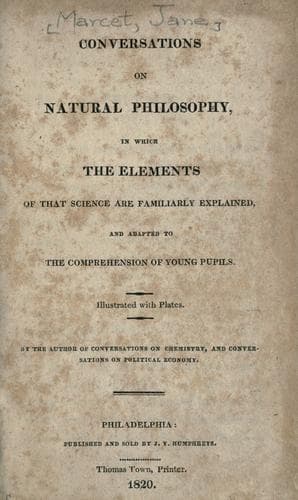
Conversations on Natural Philosophy, in which the Elements of that Science are Familiarly ExplainedMarcet, Mrs. (Jane Haldimand)
Science
Conversations on Natural Philosophy, in which the Elements of that Science are Familiarly Explained
Marcet, Mrs. (Jane Haldimand)
Physics
_Mrs. B._ This can be done by letting the coloured rays, which have been
separated by a prism, fall upon a lens, which will converge them to a
focus; and if, when thus reunited, we find that they appear white as
they did before refraction, I hope you will be convinced that the white
rays, are a compound of the several coloured rays. The prism P, you
see, (fig. 5.) separates a ray of white light, into seven coloured rays,
and the lens L L brings them to a focus at F, where they again appear
white.
_Caroline._ You succeed to perfection: this is indeed a most interesting
and conclusive experiment.
_Emily._ Yet, Mrs. B., I cannot help thinking, that there may, perhaps,
be but three distinct colours in the spectrum, red, yellow, and blue;
and that the four others may consist of two of these colours blended
together; for, in painting, we find, that by mixing red and yellow, we
produce orange; with different proportions of red and blue, we make
violet or any shade of purple; and yellow, and blue, form green. Now, it
is very natural to suppose, that the refraction of a prism, may not be
so perfect as to separate the coloured rays of light completely, and
that those which are contiguous, in order of refrangibility, may
encroach on each other, and by mixing, produce the intermediate colours,
orange, green, violet, and indigo.
_Mrs. B._ Your observation is, I believe, neither quite wrong, nor quite
right. Dr. Wollaston, who has performed many experiments on the
refraction of light, in a more accurate manner than had been previously
done, by receiving a very narrow line of light on a prism, found that it
formed a spectrum, consisting of rays of four colours only; but they
were not exactly those you have named as primitive colours, for they
consisted of red, green, blue, and violet. A very narrow line of yellow
was visible, at the limit of the red and green, which Dr. Wollaston
attributed to the overlapping of the edges of the red and green light.
_Caroline._ But red and green mixed together, do not produce yellow?
_Mrs. B._ Not in painting; but it may be so in the primitive rays of the
spectrum. Dr. Wollaston observed, that, by increasing the breadth of the
aperture, by which the line of light was admitted, the space occupied by
each coloured ray in the spectrum, was augmented, in proportion as each
portion encroached on the neighbouring colour, and mixed with it; so
that the intervention of orange and yellow, between the red and green,
is owing, he supposes, to the mixture of these two colours; and the blue
is blended on the one side with the green, and on the other with the
violet, forming the spectrum, as it was originally observed by Sir Isaac
Newton, and which I have just shown you.
Public-domain text, read in full here on John Shaqi.
Reviews
Reviews
No reviews yet
Be the first to share your thoughts on this work.
Elsewhere in the archive
Join the Discussion
Join the discussion
Sign in to leave a comment or review.
Sign InorCreate an account