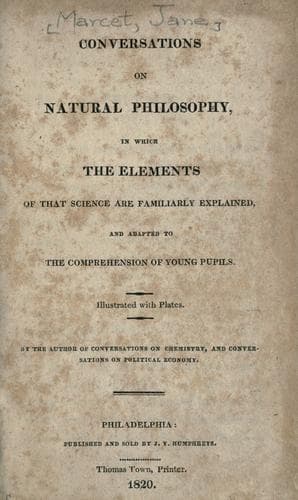
Conversations on Natural Philosophy, in which the Elements of that Science are Familiarly ExplainedMarcet, Mrs. (Jane Haldimand)
Science
Conversations on Natural Philosophy, in which the Elements of that Science are Familiarly Explained
Marcet, Mrs. (Jane Haldimand)
Physics
The rainbow, which exhibits a series of colours, so analogous to those
of the spectrum, is formed by the refraction of the sun's rays, in their
passage through a shower of rain; every drop of which acts as a prism,
in separating the coloured rays as they pass through it; the combined
effect of innumerable drops, produces the bow, which you know can be
seen, only when there are both rain, and sunshine.
_Emily._ Pray, Mrs. B., cannot the sun's rays be collected to a focus by
a lens, in the same manner as they are by a concave mirror?
_Mrs. B._ The same effect in concentrating the rays, is produced by the
refraction with a lens, as by the reflection from a concave mirror: in
the first, the rays pass through the glass and converge to a focus,
behind it, in the latter, they are reflected from the mirror, and
brought to a focus, before it. A lens, when used for the purpose of
collecting the sun's rays, is called a burning glass. I have before
explained to you, the manner in which a convex lens, refracts the rays,
and brings them to a focus; (fig. 6, plate 19.) as these rays contain
both light and heat, the latter, as well as the former, is refracted;
and intense heat, as well as light, will be found in the focal point.
The sun now shines very bright; if we let the rays fall on this lens,
you will perceive the focus.
_Emily._ Oh yes: the point of union of the rays, is very luminous. I
will hold a piece of paper in the focus, and see if it will take fire.
The spot of light is extremely brilliant, but the paper does not burn?
_Mrs. B._ Try a piece of brown paper;--that, you see, takes fire almost
immediately.
_Caroline._ This is surprising; for the light appeared to shine more
intensely, on the white, than on the brown paper.
_Mrs. B._ The lens collects an equal number of rays to a focus, whether
you hold the white or the brown paper, there; but the white paper
appears more luminous in the focus, because most of the rays, instead of
entering into the paper, are reflected by it; and this is the reason
that the paper does not readily take fire: whilst, on the contrary, the
brown paper, which absorbs more light and heat than it reflects, soon
becomes heated and takes fire.
_Caroline._ This is extremely curious; but why should brown paper,
absorb more rays, than white paper?
_Mrs. B._ I am far from being able to give a satisfactory answer to that
question. We can form but mere conjecture on this point; it is supposed
that the tendency to absorb, or reflect rays, depends on the
arrangement of the minute particles of the body, and that this diversity
of arrangement renders some bodies susceptible of reflecting one
coloured ray, and absorbing the others; whilst other bodies, have a
tendency to reflect all the colours, and others again, to absorb them
all.
_Emily._ And how do you know which colours bodies have a tendency to
reflect, or which to absorb?
Public-domain text, read in full here on John Shaqi.
Reviews
Reviews
No reviews yet
Be the first to share your thoughts on this work.
Elsewhere in the archive
Join the Discussion
Join the discussion
Sign in to leave a comment or review.
Sign InorCreate an account