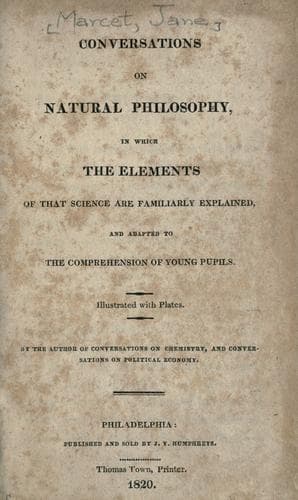
Conversations on Natural Philosophy, in which the Elements of that Science are Familiarly ExplainedMarcet, Mrs. (Jane Haldimand)
Science
Conversations on Natural Philosophy, in which the Elements of that Science are Familiarly Explained
Marcet, Mrs. (Jane Haldimand)
Physics
_Mrs. B._ Because a body always appears to be of the colour which it
reflects; for, as we see only by reflected rays, it can appear of the
colour of those rays, only.
_Caroline._ But we see all bodies of their own natural colour, Mrs. B.;
the grass and trees, green; the sky, blue; the flowers of various hues.
_Mrs. B._ True; but why is the grass green?--because it absorbs all,
except the green rays; it is, therefore, these only which the grass and
trees reflect to our eyes, and this makes them appear green. The
flowers, in the same manner, reflect the various colours of which they
appear to us; the rose, the red rays; the violet, the blue; the jonquil,
the yellow, &c.
_Caroline._ But these are the permanent colours of the grass and
flowers, whether the sun's rays shine on them or not.
_Mrs. B._ Whenever you see those colours, the flowers must be illumined
by some light; and light, from whatever source it proceeds, is of the
same nature; composed of the various coloured rays which paint the
grass, the flowers, and every coloured object in nature.
_Caroline._ But, Mrs. B., the grass is green, and the flowers are
coloured, whether in the dark, or exposed to the light?
_Mrs. B._ Why should you think so?
_Caroline._ It cannot be otherwise.
_Mrs. B._ A most philosophical reason indeed! But, as I never saw them
in the dark, you will allow me to dissent from your opinion.
_Caroline._ What colour do you suppose them to be, then, in the dark?
_Mrs. B._ None at all; or black, which is the same thing. You can never
see objects, without light. White light is compounded of rays, from
which all the colours in nature are produced; there, therefore, can be
no colour without light; and though a substance is black, or without
colour, in the dark, it may become coloured, as soon as it becomes
visible. It is visible, indeed, only by the coloured rays which it
reflects; therefore, we can see it only when coloured.
_Caroline._ All you say seems very true, and I know not what to object
to it; yet it appears at the same time incredible! What, Mrs. B., are we
all as black as negroes in the dark? you make me shudder at the thought.
_Mrs. B._ Your vanity need not be alarmed at the idea, as you are
certain of never being seen, in that state.
_Caroline._ That is some consolation, undoubtedly; but what a melancholy
reflection it is, that all nature which appears so beautifully
diversified with colours, is really one uniform mass of blackness!
_Mrs. B._ Is nature less pleasing for being coloured, as well as
illumined, by the rays of light? and are colours less beautiful, for
being accidental, rather than essential properties of bodies?
Public-domain text, read in full here on John Shaqi.
Reviews
Reviews
No reviews yet
Be the first to share your thoughts on this work.
Elsewhere in the archive
Join the Discussion
Join the discussion
Sign in to leave a comment or review.
Sign InorCreate an account