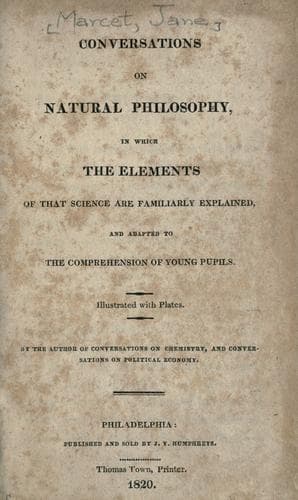
Conversations on Natural Philosophy, in which the Elements of that Science are Familiarly ExplainedMarcet, Mrs. (Jane Haldimand)
Science
Conversations on Natural Philosophy, in which the Elements of that Science are Familiarly Explained
Marcet, Mrs. (Jane Haldimand)
Physics
Providence seems to have decorated nature with the enchanting diversity
of colours, which we so much admire, for the sole purpose of beautifying
the scene, and rendering it a source of sensible gratification: it is an
ornament which embellishes nature, whenever we behold her. What reason
is there to regret, that she does not wear it when she is invisible?
_Emily._ I confess, Mrs. B., that I have had my doubts, as well as
Caroline, though she has spared me the pains of expressing them: but I
have just thought of an experiment, which, if it succeed, will, I am
sure, satisfy us both. It is certain, that we cannot see bodies in the
dark, to know whether they have then any colour. But we may place a
coloured body in a ray of light, which has been refracted by a prism;
and if your theory is true, the body, of whatever colour it naturally
is, must appear of the colour of the ray in which it is placed; for
since it receives no other coloured rays, it can reflect no others.
_Caroline._ Oh! that is an excellent thought, Emily; will you stand the
test, Mrs. B.?
_Mrs. B._ I consent: but we must darken the room, and admit only the ray
which is to be refracted; otherwise, the white rays will be reflected on
the body under trial, from various parts of the room. With what do you
choose to make the experiment?
_Caroline._ This rose: look at it, Mrs. B., and tell me whether it is
possible to deprive it of its beautiful colour?
_Mrs. B._ We shall see.--I expose it first to the red rays, and the
flower appears of a more brilliant hue; but observe the green leaves----
_Caroline._ They appear neither red nor green; but of a dingy brown with
a reddish glow?
_Mrs. B._ They cannot appear green, because they have no green rays to
reflect; neither are they red, because green bodies absorb most of the
red rays. But though bodies, from the arrangement of their particles,
have a tendency to absorb some rays, and reflect others, yet it is not
natural to suppose, that bodies are so perfectly uniform in their
arrangement, as to reflect only pure rays of one colour, and perfectly
to absorb the others; it is found, on the contrary, that a body
reflects, in great abundance, the rays which determine its colour, and
the others in a greater or less degree, in proportion as they are nearer
to or further from its own colour, in the order of refrangibility. The
green leaves of the rose, therefore, will reflect a few of the red rays,
which, blended with their natural blackness, give them that brown tinge:
if they reflected none of the red rays, they would appear perfectly
black. Now I shall hold the rose in the blue rays----
_Caroline._ Oh, Emily, Mrs. B. is right! look at the rose: it is no
longer red, but of a dingy blue colour.
_Emily._ This is the most wonderful, of any thing we have yet learnt.
But, Mrs. B., what is the reason that the green leaves, are of a
brighter blue than the rose?
Public-domain text, read in full here on John Shaqi.
Reviews
Reviews
No reviews yet
Be the first to share your thoughts on this work.
Elsewhere in the archive
Join the Discussion
Join the discussion
Sign in to leave a comment or review.
Sign InorCreate an account