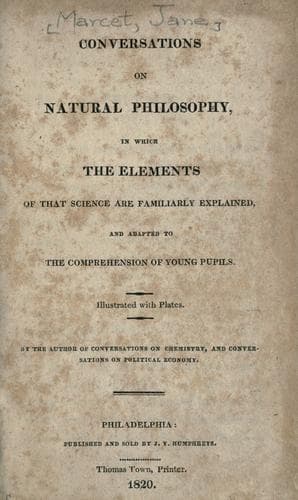
Conversations on Natural Philosophy, in which the Elements of that Science are Familiarly ExplainedMarcet, Mrs. (Jane Haldimand)
Science
Conversations on Natural Philosophy, in which the Elements of that Science are Familiarly Explained
Marcet, Mrs. (Jane Haldimand)
Physics
_Emily._ The difference between a microscope and a telescope, seems to
be this:--a microscope produces a magnified image, because the object is
nearest the lens; and a telescope produces a diminished image, because
the object is furthest from the lens.
_Mrs. B._ Your observation applies only to the lens C D, or
object-glass, which serves to bring an image of the object nearer the
eye; for the lens X Y, or eye-glass, is, in fact, a microscope, as its
purpose is to magnify the image.
When a very great magnifying power is required, telescopes are
constructed with concave mirrors, instead of lenses. These are called
reflecting telescopes, because the image is reflected by metallic
mirrors. Concave mirrors, you know, produce by reflection, an effect
similar to that of convex lenses, by refraction. In reflecting
telescopes, therefore, mirrors are used in order to bring the image
nearer the eye; and a lens, or eye-glass, the same as in the refracting
telescope, to magnify the image.
The advantage of the reflecting telescope is, that mirrors whose focus
is six feet, will magnify as much as lenses of a hundred feet: an
instrument of this kind may, therefore, possess a high magnifying power,
and yet be so short, as to be readily managed.
_Caroline._ But I thought it was the eye-glass only which magnified the
image; and that the other lens, served to bring a diminished image
nearer to the eye.
_Mrs. B._ The image is diminished in comparison with the object, it is
true; but it is magnified, if you compare it to the dimensions of which
it would appear without the intervention of any optical instrument; and
this magnifying power is greater in reflecting, than in refracting
telescopes.
We must now bring our observations to a conclusion, for I have
communicated to you the whole of my very limited stock of knowledge of
Natural Philosophy. If it enable you to make further progress in that
science, my wishes will be satisfied; but remember, in order that the
study of nature may be productive of happiness, it must lead to an
entire confidence in the wisdom and goodness of its bounteous Author.
Questions
1. (Pg. 195) What is the form of the body of the eye? fig. 1, plate 21.
2. (Pg. 195) What is its external coat called?
3. (Pg. 195) What is the transparent part of this coat denominated?
4. (Pg. 195) What is the second coat named?
5. (Pg. 195) What opening is there in this?
6. (Pg. 195) What is the coloured part which surrounds the pupil?
7. (Pg. 195) The pupils dilate and contract, what purpose does this
answer?
8. (Pg. 196) How could you observe the dilatation and contraction of the
pupils?
9. (Pg. 196) What purpose is the choroid said to answer?
10. (Pg. 196) In what animals is the change in the iris greatest?
11. (Pg. 196) What are the three humours denominated, and how are they
situated?
12. (Pg. 197) What is the part represented at _i i_, and of what does it
consist?
Public-domain text, read in full here on John Shaqi.
Reviews
Reviews
No reviews yet
Be the first to share your thoughts on this work.
Elsewhere in the archive
Join the Discussion
Join the discussion
Sign in to leave a comment or review.
Sign InorCreate an account