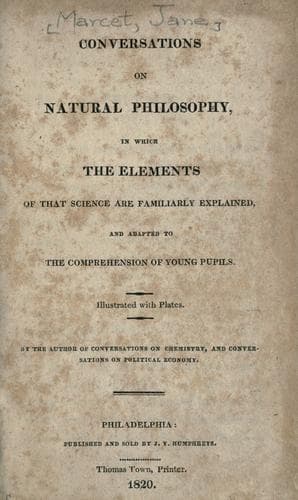
Conversations on Natural Philosophy, in which the Elements of that Science are Familiarly ExplainedMarcet, Mrs. (Jane Haldimand)
Science
Conversations on Natural Philosophy, in which the Elements of that Science are Familiarly Explained
Marcet, Mrs. (Jane Haldimand)
Physics
13. (Pg. 197) What are the respective uses of the humours, and of the
retina?
14. (Pg. 197) Why is it necessary the rays should be refracted?
15. (Pg. 197) How is this illustrated by fig. 3 and 4, plate 21?
16. (Pg. 198) What causes a person to be short-sighted? fig. 5, plate
21.
17. (Pg. 198) Why does placing an object near the eye, enable such, to
see distinctly? fig. 6.
18. (Pg. 199) A concave lens remedies this defect; how? fig. 1, plate
22.
19. (Pg. 199) What is the remedy, when a person is long-sighted? fig. 2.
20. (Pg. 199) Why does holding an object far from the eye, help such
persons? fig. 3.
21. (Pg. 200) How is the eye said to adapt itself to distant, and to
near objects?
22. (Pg. 200) Why are objects rendered indistinct, when placed very near
to the eye? fig. 4, plate 22.
23. (Pg. 200) What is the single microscope, fig. 5, and how does it
magnify objects?
24. (Pg. 201) How may objects be magnified without the aid of a lens?
25. (Pg. 201) Why can an object, very near to the eye, be distinctly
seen, when viewed through a small hole?
26. (Pg. 201) Describe the double microscope, as represented in fig. 6,
plate 22.
27. (Pg. 202) How does the solar microscope, (fig. 1 plate 23.) operate?
28. (Pg. 202) Why may minute objects be greatly magnified by this
instrument?
29. (Pg. 202) In its more perfect form it has other appendages, as seen
in fig. 2, what are they? and what their uses?
30. (Pg. 203) What is added when opaque objects are to be viewed? fig.
3.
31. (Pg. 203) In what does the magic lanthorn differ from the solar
microscope?
32. (Pg. 203) What are the use and structure of the telescope, as shown
in fig. 4?
33. (Pg. 204) When terrestrial objects are to be viewed, why are two
additional lenses employed?
34. (Pg. 204) What part of the telescope performs the part of a
microscope?
35. (Pg. 204) In what does the reflecting, differ from the refracting
telescope?
36. (Pg. 204) What advantages, do reflecting, possess over refracting
telescopes?
GLOSSARY.
ACCELERATED MOTION. Motion is said to be accelerated, when the velocity
is continually increasing.
ACCIDENTAL PROPERTIES. Those properties of bodies which are liable to
change, as colour, form, &c.
ACUTE.--See ANGLE.
AIR. An elastic fluid. The atmosphere which surrounds the earth, is
generally understood by this term, but there are many kinds of air. The
term is synonymous with _Gas_.
AIR PUMP. An instrument by which vessels may be exhausted of air.
ALTITUDE. The height in degrees of the sun, or any heavenly body, above
the horizon.
Public-domain text, read in full here on John Shaqi.
Reviews
Reviews
No reviews yet
Be the first to share your thoughts on this work.
Elsewhere in the archive
Join the Discussion
Join the discussion
Sign in to leave a comment or review.
Sign InorCreate an account