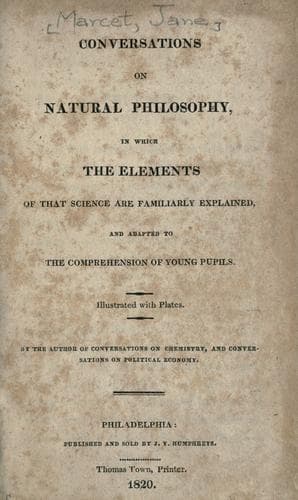
Conversations on Natural Philosophy, in which the Elements of that Science are Familiarly ExplainedMarcet, Mrs. (Jane Haldimand)
Science
Conversations on Natural Philosophy, in which the Elements of that Science are Familiarly Explained
Marcet, Mrs. (Jane Haldimand)
Physics
_Mrs. B._ Unless we proceed with some degree of order and method, you
will in the end find yourself but little the wiser for all you learn.
Let us therefore go on regularly, and make ourselves well acquainted
with the general properties of bodies before we proceed further.
_Emily._ To return, then, to attraction, (which appears to me by far the
most interesting of them, since it belongs equally to all kinds of
matter,) it must be mutual between two bodies; and if so, when a stone
falls to the earth, the earth should rise part of the way to meet the
stone?
_Mrs. B._ Certainly; but you must recollect that the force of attraction
is proportioned to the quantity of matter which bodies contain, and if
you consider the difference there is in that respect, between a stone
and the earth, you will not be surprised that you do not perceive the
earth rise to meet the stone; for though it is true that a mutual
attraction takes place between the earth and the stone, that of the
latter is so very small in comparison to that of the former, as to
render its effect insensible.
_Emily._ But since attraction is proportioned to the quantity of matter
which bodies contain, why do not the hills attract the houses and
churches towards them?
_Caroline._ What an idea, Emily! How can the houses and churches be
moved, when they are so firmly fixed in the ground!
_Mrs. B._ Emily's question is not absurd, and your answer, Caroline, is
perfectly just; but can you tell us why the houses and churches are so
firmly fixed in the ground?
_Caroline._ I am afraid I have answered right by mere chance; for I
begin to suspect that bricklayers and carpenters could give but little
stability to their buildings, without the aid of attraction.
_Mrs. B._ It is certainly the cohesive attraction between the bricks and
the mortar, which enables them to build walls, and these are so strongly
attracted by the earth, as to resist every other impulse; otherwise they
would necessarily move towards the hills and the mountains; but the
lesser force must yield to the greater. There are, however, some
circumstances in which the attraction of a large body has sensibly
counteracted that of the earth. If whilst standing on the declivity of a
mountain, you hold a plumb-line in your hand, the weight will not fall
perpendicular to the earth, but incline a little towards the mountain;
and this is owing to the lateral, or sideways attraction of the
mountain, interfering with the perpendicular attraction of the earth.
_Emily._ But the size of a mountain is very trifling, compared to the
whole earth.
_Mrs. B._ Attraction, you must recollect, is in proportion to the
quantity of matter, and although that of the mountain, is much less than
that of the earth, it may yet be sufficient to act sensibly upon the
plumb-line which is so near to it.
_Caroline._ Pray, Mrs. B., do the two scales of a balance hang parallel
to each other?
Public-domain text, read in full here on John Shaqi.
Reviews
Reviews
No reviews yet
Be the first to share your thoughts on this work.
Join the Discussion
Join the discussion
Sign in to leave a comment or review.
Sign InorCreate an account