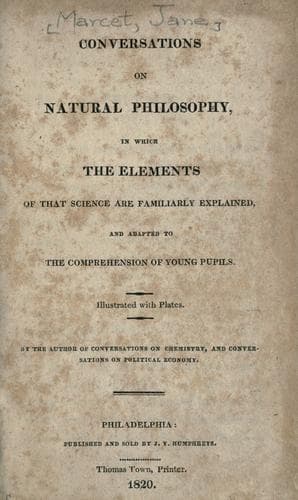
Conversations on Natural Philosophy, in which the Elements of that Science are Familiarly ExplainedMarcet, Mrs. (Jane Haldimand)
Science
Conversations on Natural Philosophy, in which the Elements of that Science are Familiarly Explained
Marcet, Mrs. (Jane Haldimand)
Physics
_Mrs. B._ You mean, I suppose, in other words to inquire whether two
lines which are perpendicular to the earth, are parallel to each other?
I believe I guess the reason of your question; but I wish you would
endeavour to answer it without my assistance.
_Caroline._ I was thinking that such lines must both tend by gravity to
the same point, the centre of the earth; now lines tending to the same
point cannot be parallel, as parallel lines are always at an equal
distance from each other, and would never meet.
_Mrs. B._ Very well explained; you see now the use of your knowledge of
parallel lines: had you been ignorant of their properties, you could not
have drawn such a conclusion. This may enable you to form an idea of the
great advantage to be derived even from a slight knowledge of geometry,
in the study of natural philosophy; and if after I have made you
acquainted with the first elements, you should be tempted to pursue the
study, I would advise you to prepare yourselves by acquiring some
knowledge of geometry. This science would teach you that lines which
fall perpendicular to the surface of a sphere cannot be parallel,
because they would all meet, if prolonged to the centre of the sphere;
while lines that fall perpendicular to a plane or flat surface, are
always parallel, because if prolonged, they would never meet.
_Emily._ And yet a pair of scales, hanging perpendicular to the earth,
appear parallel?
_Mrs. B._ Because the sphere is so large, and the scales consequently
converge so little, that their inclination is not perceptible to our
senses; if we could construct a pair of scales whose beam would extend
several degrees, their convergence would be very obvious; but as this
cannot be accomplished, let us draw a small figure of the earth, and
then we may make a pair of scales of the proportion we please. (fig. 1.
pl. I.)
_Caroline._ This figure renders it very clear: then two bodies cannot
fall to the earth in parallel lines?
_Mrs. B._ Never.
_Caroline._ The reason that a heavy body falls quicker than a light one,
is, I suppose, because the earth attracts it more strongly.
_Mrs. B._ The earth, it is true, attracts a heavy body more than a light
one; but that would not make the one fall quicker than the other.
_Caroline._ Yet, since it is attraction that occasions the fall of
bodies, surely the more a body is attracted, the more rapidly it will
fall. Besides, experience proves it to be so. Do we not every day see
heavy bodies fall quickly, and light bodies slowly?
_Emily._ It strikes me, as it does Caroline, that as attraction is
proportioned to the quantity of matter, the earth must necessarily
attract a body which contains a great quantity more strongly, and
therefore bring it to the ground sooner than one consisting of a smaller
quantity.
Public-domain text, read in full here on John Shaqi.
Reviews
Reviews
No reviews yet
Be the first to share your thoughts on this work.
Join the Discussion
Join the discussion
Sign in to leave a comment or review.
Sign InorCreate an account