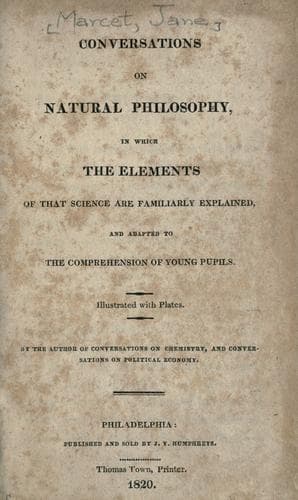
Conversations on Natural Philosophy, in which the Elements of that Science are Familiarly ExplainedMarcet, Mrs. (Jane Haldimand)
Science
Conversations on Natural Philosophy, in which the Elements of that Science are Familiarly Explained
Marcet, Mrs. (Jane Haldimand)
Physics
ANGLE. The space contained between two lines inclined to each other, and
which meet in a point. Angles are measured in degrees, upon a segment of
a circle described by placing one leg of a pair of compasses on the
angular point, and with the other, describing the segment between the
two lines. If the segment be exactly 1-4th of a circle, it is called a
_right_ angle, and contains 90 deg. If more than 1-4th of a circle, it
is an _obtuse_ angle. If less, an _acute_ angle. See plate 2.
ANGLE OF INCIDENCE, is the space contained between a ray which falls
obliquely upon a body, and a line perpendicular to the surface of the
body, at the point where the ray falls.
ANGLE OF REFLECTION. The space contained between a reflected ray, and a
line perpendicular to the reflecting point.
ANGLE OF VISION, or visual angle. The space contained between lines
drawn from the extreme parts of any object, and meeting in the eye.
ANTARCTIC CIRCLE. A circle extending round the south pole, at the
distance of 23 1-2 degrees from it. The same as the south frigid zone.
APHELION. That part of the orbit of a planet, in which its distance from
the sun is the greatest.
AREA. The surface enclosed between the lines which form the boundary of
any figure, whether regular or irregular.
ARIES. See SIGN.
ASTEROIDS. The name given to the four small planets, Ceres, Juno,
Pallas, and Vesta.
ASTRONOMY. The science which treats of the motion and other phenomena of
the sun, the planets, the stars, and the other heavenly bodies.
ATMOSPHERE. The air which surrounds the earth, extending to an unknown
height. Wind is this air in motion.
ATTRACTION. A tendency in bodies to approach each other, and to exist in
contact.
ATTRACTION OF COHESION. That attraction which causes matter to remain in
masses, preventing them from falling into powder. For this attraction to
exist, the particles must be contiguous.
ATTRACTION OF GRAVITATION. By this attraction, masses of matter, placed
at a distance, have a tendency to approach each other. Attraction is
mutual between the sun and the planets.
AXIS OF THE EARTH, OR OF ANY OF THE PLANETS. An imaginary line passing
through their centres, and terminating at their poles; round this their
diurnal revolutions are performed.
AXIS OF MOTION. The imaginary line, around which all the parts of a body
revolve, when it has a spinning motion.
AXIS OF A LENS, OR MIRROR. A line passing through the centre of a lens,
or mirror, in a direction perpendicular to its surface.
BALLOON. Any hollow globe. The term is generally applied to those which
are made to ascend in the air.
BAROMETER. Commonly called a weather-glass. It has a glass tube,
containing quicksilver, which by rising and falling, indicates any
change in the pressure of the atmosphere, and thus frequently warns us
of changes in the weather.
Public-domain text, read in full here on John Shaqi.
Reviews
Reviews
No reviews yet
Be the first to share your thoughts on this work.
Elsewhere in the archive
Join the Discussion
Join the discussion
Sign in to leave a comment or review.
Sign InorCreate an account