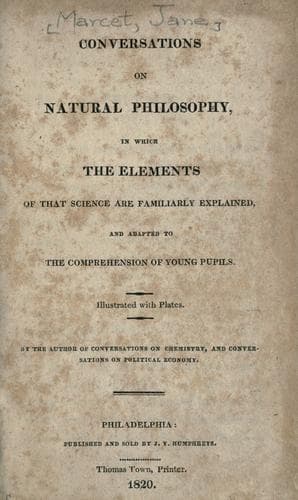
Conversations on Natural Philosophy, in which the Elements of that Science are Familiarly ExplainedMarcet, Mrs. (Jane Haldimand)
Science
Conversations on Natural Philosophy, in which the Elements of that Science are Familiarly Explained
Marcet, Mrs. (Jane Haldimand)
Physics
BODY. The same as _Matter_. It may exist in the solid, liquid, or
æriform state; and includes every thing with which we become acquainted
by the aid of the senses.
BURNING-GLASS, OR MIRROR. A lens, or a mirror, by which the rays of
light, and heat, are brought to a focus, so as to set bodies on fire.
CAMERA OBSCURA, a darkened room; or more frequently a box, admitting
light by one opening, where a lens is placed; which, bringing the rays
of light, from external objects, to a focus, presents a perfect picture
of them, in miniature.
CAPILLARY TUBES. Tubes, the bore of which is very small. Glass tubes are
usually employed, to show the phenomenon of _capillary attraction_.
Fluids in which they are immersed, rise in such tubes above the level of
that in the containing vessel.
CENTRE OF A CIRCLE. A point, equally distant from every part of its
circumference.
CENTRE OF GRAVITY. That point within a body, to which all its particles
tend, and around which they exactly balance each other. A system of
bodies, as the planets, may have a common centre of gravity, around
which they revolve in their orbits; whilst each, like the earth, has its
particular centre of gravity within itself.
CENTRE OF MOTION. That point about which the parts of a revolving body
move, which point is, itself, considered as in a state of rest.
CENTRE OF MAGNITUDE. The middle point of any body. Suppose a globe, one
side of which is formed of lead, and the other of wood, the centres of
magnitude and of gravity, would not be in the same points.
CENTRAL FORCES. Those which either impel a body towards, or from, a
centre of motion.
CENTRIFUGAL. That which gives a tendency to fly from a centre.
CENTRIPETAL. That which impels a body, towards a centre.
CIRCLE. A figure; the periphery, or circumference of which, is every
where equally distant, from the point, called its centre.
CIRCLE, GREAT. On the globe, or earth, is one that divides it into two
equal parts, or hemispheres. The equator, and meridian lines, are great
circles.
CIRCLE, LESSER. Those which divide the globe into unequal parts. The
tropical, arctic and antarctic circles, and all parallels of latitude,
are lesser circles.
CIRCUMFERENCE. The boundary line of any surface, as that which surrounds
the centre of a circle; the four sides of a square, &c.
COMETS. Bodies which revolve round the sun, in very long ovals,
approaching him very nearly in their perihelion, but in their aphelion,
passing to a distance immeasurably great.
COHESION. See ATTRACTION.
COMPRESSIBLE. Capable of being forced into a smaller space.
CONCAVE. Hollowed out; the inner surface of a watch-glass is concave,
and may represent the form of a _concave mirror_, or _lens_.
CONVEX. Projecting, or bulging out, as the exterior surface of a
watch-glass, which may represent the form of a _convex mirror_, or
_lens_.
CONE. A body somewhat resembling a sugar-loaf; that is, having a round
base, and sloping at the sides, until it terminates in a point.
Public-domain text, read in full here on John Shaqi.
Reviews
Reviews
No reviews yet
Be the first to share your thoughts on this work.
Elsewhere in the archive
Join the Discussion
Join the discussion
Sign in to leave a comment or review.
Sign InorCreate an account