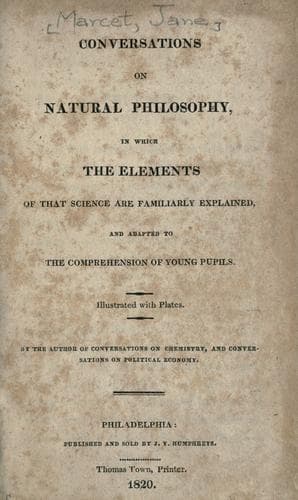
Conversations on Natural Philosophy, in which the Elements of that Science are Familiarly ExplainedMarcet, Mrs. (Jane Haldimand)
Science
Conversations on Natural Philosophy, in which the Elements of that Science are Familiarly Explained
Marcet, Mrs. (Jane Haldimand)
Physics
CONJUNCTION. When three of the heavenly bodies are in a straight or
right line, if you take either of the extreme bodies, the other two are
in conjunction with it; because a straight line drawn from it, might
pass through the centres of both, and join them together. At the time of
new moon, the moon and sun are in conjunction with the earth; and the
moon and earth, are in conjunction with the sun.
CONSTELLATION, OR SIGN. A collection of stars. Astronomers have imagined
pictures drawn in the heavens, so as to embrace a number of contiguous
stars, and have named the group after the animal, or other article
supposed to be drawn; an individual star is generally designated by its
fancied location; as upon the ear of _Leo_, the Lion, &c.
CONVERGENT RAYS, are those which approach each other, so as eventually
to meet in the same point.
CRYSTALS. Bodies of a regular form, having flat surfaces, and well
defined angles. Nitre, and other salts, are familiar examples. Many
masses of matter, are composed of crystals too minute to be discerned
without glasses.
CURVILINEAR, consisting of a line which is not straight, as a portion of
a circle, of an oval, or any curved line.
CYLINDER. A body in the form of a roller, having flat circular ends, and
being of equal diameter throughout.
DEGREE. If a circle of any size be divided into 360 equal parts, each of
these parts is called a degree. One quarter of a circle contains ninety
degrees; one twelfth of a circle, thirty degrees. The actual length of a
degree, must depend upon the size of the circle. A degree upon the
equator, upon a meridian, or any great circle of the earth, is equal to
69-1/2 miles.
Straight lines are sometimes divided into equal parts, called degrees;
but these divisions are arbitrary, bearing no relationship to the
degrees upon a circle.
DENSITY. Closeness of texture. When two bodies are equal in bulk, that
which weighs the most, has the greatest density.
DIAGONAL. A line drawn so as to connect two remote angles of a square,
or other four-sided figure.
DILATATION. The act of increasing in size. Bodies in general, dilate
when heated, and contract by cooling.
DISCORD. When the vibrations of the air, produced by two musical tones,
do not bear a certain ratio to each other, a jarring sound is produced,
which is called discord.
DIVERGENT RAYS. Those which proceed from the same point, but are
continually receding from each other.
DIVISIBILITY. Capability of being divided, or of having the parts
separated from each other. This is called one of the _essential
properties_ of matter; because, however minute the particles may be,
they must still contain as many halves, quarters, &c. as the largest
mass of matter.
ECHO. A sound reflected back, by some substance, so situated as to
produce this effect.
Public-domain text, read in full here on John Shaqi.
Reviews
Reviews
No reviews yet
Be the first to share your thoughts on this work.
Elsewhere in the archive
Join the Discussion
Join the discussion
Sign in to leave a comment or review.
Sign InorCreate an account