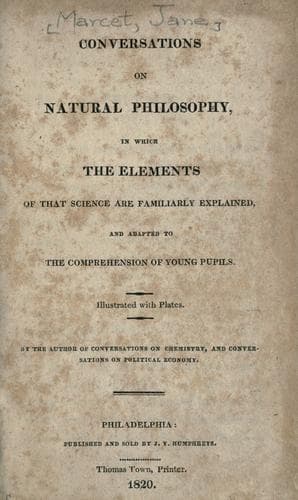
Conversations on Natural Philosophy, in which the Elements of that Science are Familiarly ExplainedMarcet, Mrs. (Jane Haldimand)
Science
Conversations on Natural Philosophy, in which the Elements of that Science are Familiarly Explained
Marcet, Mrs. (Jane Haldimand)
Physics
ECLIPSE. The interruption of the light of the sun, or of some other
heavenly body, by the intervention of an opaque body. The moon passing
between the earth and the sun, causes an eclipse of the latter.
ECLIPTIC. A circle in the heavens. The apparent path of the sun, through
the twelve signs of the zodiac. This is caused by the actual revolution
of the earth, round the sun. It is called the ecliptic, because eclipses
always happen in the direction of that line, from the earth.
ELASTICITY. That property of bodies, by which they resume their
dimensions and form, when the force which changed them is removed. Air
is eminently elastic. Two ivory balls, struck together, become flattened
at the point of contact; but immediately resuming their form, they react
upon each other.
ELLIPSIS. An oval. This figure differs from a circle, in being unequal
in its diameters, and in having two centres, or points, called its
_foci_. The orbits of the planets are all elliptical.
EQUATOR. That imaginary line which divides the earth into northern and
southern hemispheres, and which is equally distant from each pole.
EQUILIBRIUM. When two articles exactly balance each other, they are in
equilibrium. They may, notwithstanding, be very unequal in weight, but
they must be so situated, that, if set in motion, their momentums would
be equal.
EQUINOX. The two periods of time at which the nights and days are every
where of equal length. The _vernal_ equinox is in March, when the sun
enters the sign _Aries_; the _autumnal_ equinox in September, when the
sun enters _Libra_. At these periods, the sun is vertical at the
equator.
EXHALATIONS. All those articles which arise from the earth, and mixing
with the atmosphere, form vapour.
EXPANSION. The same as dilatation, which see.
EXTENSION. One of the essential properties of matter; that by which it
occupies some space, to the exclusion of all other matter.
FIGURE. All matter must exist in some form, or shape; hence figure is
deemed an essential property of matter.
FLUID. A form of matter, in which its particles readily flow, or slide,
over each other. Airs, or gases, are called elastic fluids, because they
are readily reduced to a smaller bulk by pressure. Liquids, are
denominated non-elastic fluids, because they suffer but little
diminution of bulk, by any mechanical force.
FOCUS. That point in which converging rays unite.
FORCE. That power which acts upon a body, either tending to create, or
to stop motion.
FOUNTAIN. A jet, or stream of water, forced upwards by the weight of
other water, by the elasticity of air, or some other mechanical
pressure.
FRICTION. The rubbing of bodies together, by which their motion is
retarded. Friction may be lessened, but cannot be destroyed.
FRIGID ZONES. The spaces or areas, contained within the arctic and
antarctic circles.
FULCRUM. A prop. The point or axis, by which a body is supported, and
about which it is susceptible of motion.
Public-domain text, read in full here on John Shaqi.
Reviews
Reviews
No reviews yet
Be the first to share your thoughts on this work.
Elsewhere in the archive
Join the Discussion
Join the discussion
Sign in to leave a comment or review.
Sign InorCreate an account