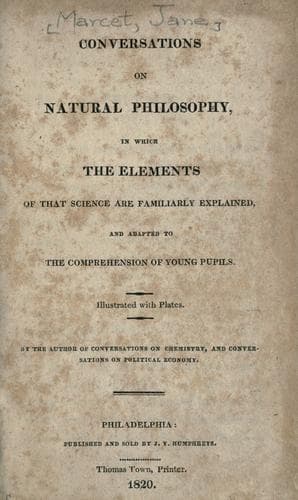
Conversations on Natural Philosophy, in which the Elements of that Science are Familiarly ExplainedMarcet, Mrs. (Jane Haldimand)
Science
Conversations on Natural Philosophy, in which the Elements of that Science are Familiarly Explained
Marcet, Mrs. (Jane Haldimand)
Physics
GAS. Any kind of air; of these there are several. The atmosphere
consists of two kinds, mixed, or combined with each other.
GEOMETRY. That branch of the mathematics, which treats of lines, of
surfaces, and of solids; and investigates their properties, and
proportions.
GLOBE. A sphere, or ball. It has a point in its centre of magnitude,
from which its surface is every where equally distant.
GRAVITY. That species of attraction which appears to be common to
matter, existing in its particles, and giving to them, and of course to
the masses which they compose, a tendency to approach each other. By
gravity a stone falls to the earth, and by it the heavenly bodies tend
towards each other.
HARMONY. A combination of musical sounds, produced by vibrations which
bear a certain ratio to each other; and which thence affect the mind
agreeably, when heard at the same time. Sounds not so related, produce
discord.
HEMISPHERE. Half a sphere or globe. A plane passing through the centre
of a globe, will divide it into hemispheres.
HORIZON. This is generally divided into _sensible_, and _rational_. The
sensible horizon is that portion of the surface of the earth, to which
our vision extends. Our rational horizon is that circle in the heavens
which bounds our vision, when on the ocean, an extended plane, or any
elevated situation. In the heavens our sensible, and our rational
horizon are the same; its plane would divide the earth into hemispheres
at 90 degrees from us; and a person standing on that part of the earth
which is directly opposite to us, would, at the same moment, see in his
horizon, the same heavenly bodies, which would be seen in ours.
HORIZONTAL. Level; not inclined, or sloping. A perfectly round ball,
placed upon a flat surface, which is placed horizontally, will remain at
rest.
HYDRAULICS. That science which treats of water in motion, and the means
of raising, conducting, and using it for moving machinery, or other
purposes.
HYDROSTATICS. Treats of the weight, pressure, and equilibrium of fluids,
when in a state of rest.
HYDROMETER. An instrument used to ascertain the specific gravity of
different fluids, which it does, by the depth to which it sinks when
floating on them.
IMAGE. The picture of any object which we perceive either by reflected
or refracted light. All objects which are visible, become so by forming
images on the retina.
IMPENETRABILITY. That property of matter, by which it excludes all other
matter from occupying the same space with itself at the same time. If
two particles could exist in the same space, so also might any greater
number, and indeed all the matter in the universe, might be collected in
a single point.
INCIDENCE. The direction in which a body, or a ray of light, moves in
its approach towards any substance, upon which it strikes.
INCLINED PLANE. One of the six mechanical powers. Any plane surface
inclined to the horizon, may be so denominated.
Public-domain text, read in full here on John Shaqi.
Reviews
Reviews
No reviews yet
Be the first to share your thoughts on this work.
Elsewhere in the archive
Join the Discussion
Join the discussion
Sign in to leave a comment or review.
Sign InorCreate an account