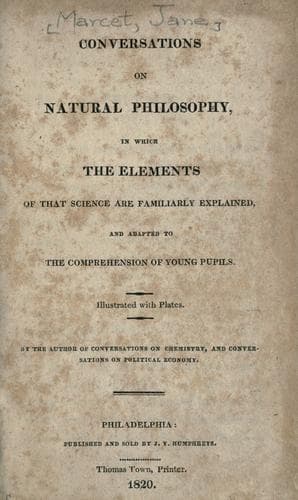
Conversations on Natural Philosophy, in which the Elements of that Science are Familiarly ExplainedMarcet, Mrs. (Jane Haldimand)
Science
Conversations on Natural Philosophy, in which the Elements of that Science are Familiarly Explained
Marcet, Mrs. (Jane Haldimand)
Physics
INERTIA. One of the inherent properties of matter. Want of power, or of
any active principle within itself, by which it can change its own
state, whether of motion, or of rest.
INHERENT PROPERTIES. Those properties which are absolutely necessary to
the existence of a body; called also essential properties. All others
are denominated accidental. Colour is an accidental--extension, an
essential property of matter.
LATITUDE. Distance from the equator, in a direct line towards either
pole. This distance is measured in degrees and minutes. The degree of
latitude cannot exceed ninety, or one quarter of a circle. Places to the
south of the equator, are in south latitude, and those to the north, in
north latitude.
LATITUDE, PARALLELS OF. Lines drawn upon the globe, parallel to the
equator, are so called; every place situated on such a line, has the
same latitude, because equally distant from the equator.
LENS. A glass, ground so that one or both surfaces form segments of a
sphere, serving either to magnify, or diminish objects seen through
them. Glasses used in spectacles are lenses.
LEVER. One of the mechanical powers. An inflexible bar of wood or metal,
supported by a fulcrum, or prop; and employed to increase the effect of
a given power.
LIBRA. One of the twelve signs of the zodiac. That into which the sun
enters, at the autumnal equinox.
LIGHT. That principle, by the aid of which we are able to discern all
visible objects. It is generally believed to be a substance emitted by
luminous bodies, and, exciting vision by passing into the eye.
LONGITUDE. Distance measured in degrees and minutes, either in an
eastern, or a western direction, from any given point either on the
equator, or on a parallel of latitude. Degrees of longitude may amount
to 180, or half a circle. A degree of longitude measured upon the
equator, is of the same length with a degree of latitude; but as the
poles are approached, the degrees of longitude diminish in length,
because the circles upon which they are measured, become less.
LUNAR. Relating to _Luna_, the moon.
LUNATION. The time in which the moon completes its circuit. A lunar
month.
LUMINOUS BODIES. Those which emit light from their own substance; not
shining by borrowed, or reflected light.
MACHINE. Any instrument, either simple or compound, by which any
mechanical effect is produced. A needle, and a clock, are both machines.
MAGIC LANTHORN, OR LANTERN. An optical instrument, by which transparent
pictures, painted upon glass, are magnified and exhibited on a white
wall or screen, in a darkened room. The phantasmagoria, is a species of
magic lanthorn.
MATHEMATICS. The science of numbers and of extension. Common arithmetic,
is a lower branch of the mathematics. In its higher departments, it
extends to every thing which is capable of being either numbered or
measured.
Public-domain text, read in full here on John Shaqi.
Reviews
Reviews
No reviews yet
Be the first to share your thoughts on this work.
Elsewhere in the archive
Join the Discussion
Join the discussion
Sign in to leave a comment or review.
Sign InorCreate an account