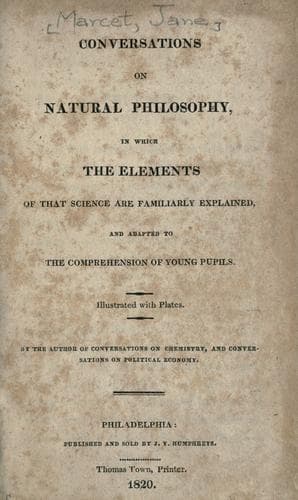
Conversations on Natural Philosophy, in which the Elements of that Science are Familiarly ExplainedMarcet, Mrs. (Jane Haldimand)
Science
Conversations on Natural Philosophy, in which the Elements of that Science are Familiarly Explained
Marcet, Mrs. (Jane Haldimand)
Physics
MATTER. Substance. Every thing with which we become acquainted by the
aid of the senses; every thing however large, or however minute, which
has length, breadth, and thickness.
MECHANICS. That science which investigates the principles, upon which
the action of every machine depends; and teaches their proper
application in overcoming resistance, and in producing motion, in all
the useful purposes to which they are applied.
MEDIUM. In optics, is any body which transmits light. Air, water, glass,
and all other transparent bodies, are media. Medium also denotes that in
which any body moves. Air is the medium which conveys sound, and which
enables birds to fly.
MELODY. A succession of such single musical sounds, as form a simple air
or tune.
MERCURY. That planet which is nearest to the sun. Quicksilver, a metal,
which remains fluid at the common temperature of the atmosphere. It is
capable of being rendered solid, by intense cold.
MERIDIAN. Midday. A meridian line, is one which extends directly from
one pole of the earth to the other; crossing the equator at right
angles. It is therefore half of a great circle. The hour of the day is
the same at every place situated on the same meridian. Longitude is
measured from any given meridian, to the opposite meridian. Places at
the same distance in degrees, to the east or west of any meridian, have
the same longitude.
MICROSCOPE. An optical instrument, by which minute objects, are
magnified, so as to enable us to perceive and examine such as could not
be seen by the naked eye.
MINERAL. Earths, stones, metals, salts, and in general all substances
dug out of the earth, are denominated minerals.
MINUTE. In time, the sixtieth part of an hour. In length, the sixtieth
part of a degree. A minute of time, is an unvarying period; but a minute
in length varies in extent, with the degree of which it forms a part.
The degrees and minutes are equal in number, upon a common ring, upon
the equator of the earth, or, on any circle of the heavens.
MIRRORS. Polished surfaces of metal, or of glass coated with metal, for
the purpose of reflecting the rays of light, and the images of objects.
Common looking-glasses, are mirrors. Those used in reflecting
telescopes, are made of metal.
MOBILITY. Capable of being moved from one place to another. This is
accounted one of the essential properties of matter, because we cannot
conceive of its existence without this capacity.
MOMENTUM. The force, or power, with which a body in motion acts upon any
other body, or tends to preserve its own quantity of motion. The
momentum of a body, is compounded of its quantity of matter, and its
velocity. A body weighing one pound, moving with a velocity of two miles
in a minute, will possess the same momentum with one weighing two
pounds, moving with a velocity of one mile in a minute.
Public-domain text, read in full here on John Shaqi.
Reviews
Reviews
No reviews yet
Be the first to share your thoughts on this work.
Elsewhere in the archive
Join the Discussion
Join the discussion
Sign in to leave a comment or review.
Sign InorCreate an account