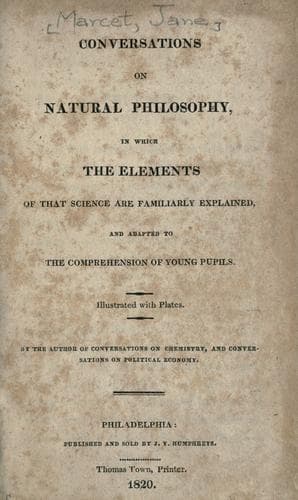
Conversations on Natural Philosophy, in which the Elements of that Science are Familiarly ExplainedMarcet, Mrs. (Jane Haldimand)
Science
Conversations on Natural Philosophy, in which the Elements of that Science are Familiarly Explained
Marcet, Mrs. (Jane Haldimand)
Physics
_Caroline._ We know also by experience, that the heavier a body is, the
greater is its force; it is not therefore difficult to understand, that
the whole power, or momentum of a body, must be composed of these two
properties, its weight and its velocity: but I do not understand why
they should be _multiplied_, the one by the other; I should have
supposed that the quantity of matter, should have been _added_ to the
quantity of motion?
_Mrs. B._ It is found by experiment, that if the weight of a body is
represented by the number 3, and its velocity also by 3, its momentum
will be represented by 9, not by 6, as would be the case, were these
figures added, instead of being multiplied together.
_Emily._ I think that I now understand the reason of this; if the
quantity of matter is increased three-fold, it must require three times
the force to move it with the same velocity; and then if we wish to give
it three times the velocity, it will again require three times the force
to produce that effect, which is three times three, or nine; which
number therefore, would represent the momentum.
_Caroline._ I am not quite sure that I fully comprehend what is
intended, when weight, and velocity, are represented by numbers alone; I
am so used to measure space by yards and miles, and weight by pounds and
ounces, that I still want to associate them together in my mind.
_Mrs. B._ This difficulty will be of very short duration: you have only
to be careful, that when you represent weights and velocities by
numbers, the denominations or values of the weights and spaces, must not
be changed. Thus, if we estimate the weight of one body in ounces, the
weight of others with which it is compared, must be estimated in ounces,
and not in pounds; and in like manner, in comparing velocities, we must
throughout, preserve the same standards both of space and of time; as
for instance, the number of feet in one second, or of miles in one hour.
_Caroline._ I now understand it perfectly, and think that I shall never
forget a thing which you have rendered so clear.
_Mrs. B._ I recommend it to you to be very careful to remember the
definition of the momentum of bodies, as it is one of the most important
points in mechanics: you will find that it is from opposing velocity, to
quantity of matter, that machines derive their powers.
The _reaction_ of bodies, is the next law of motion which I must explain
to you. When a body in motion strikes against another body, it meets
with resistance from it; the resistance of the body at rest will be
equal to the blow struck by the body in motion; or to express myself in
philosophical language, _action_ and _reaction_ will be equal, and in
opposite directions.
_Caroline._ Do you mean to say, that the action of the body which
strikes, is returned with equal force by the body which receives the
blow?
_Mrs. B._ Exactly.
Public-domain text, read in full here on John Shaqi.
Reviews
Reviews
No reviews yet
Be the first to share your thoughts on this work.
Join the Discussion
Join the discussion
Sign in to leave a comment or review.
Sign InorCreate an account