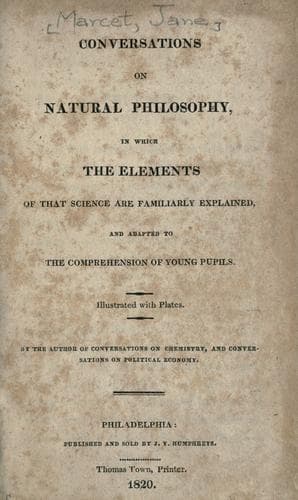
Conversations on Natural Philosophy, in which the Elements of that Science are Familiarly ExplainedMarcet, Mrs. (Jane Haldimand)
Science
Conversations on Natural Philosophy, in which the Elements of that Science are Familiarly Explained
Marcet, Mrs. (Jane Haldimand)
Physics
_Caroline._ Now I understand it; the effects of preceding impulses
continue, whilst gravity constantly adds new ones, and thus the velocity
is perpetually increased.
_Mrs. B._ Yes; it has been ascertained, both by experiment, and
calculations which it would be too difficult for us to enter into, that
heavy bodies near the surface of the earth, descending from a height by
the force of gravity, fall sixteen feet the first second of time, three
times that distance in the next, five times in the third second, seven
times in the fourth, and so on, regularly increasing their velocities in
the proportion of the odd numbers 1, 3, 5, 7, 9, &c. according to the
number of seconds during which the body has been falling.
_Emily._ If you throw a stone perpendicularly upwards, is it not the
same length of time in ascending, that it is in descending?
_Mrs. B._ Exactly; in ascending, the velocity is diminished by the force
of gravity; in descending, it is accelerated by it.
_Caroline._ I should then imagine that it would fall, quicker than it
rose?
_Mrs. B._ You must recollect that the force with which it is projected,
must be taken into the account; and that this force is overcome and
destroyed by gravity, before the body begins to fall.
_Caroline._ But the force of projection given to a stone in throwing it
upwards, cannot always be equal to the force of gravity in bringing it
down again; for the force of gravity is always the same, whilst the
degree of impulse given to the stone is optional; I may throw it up
gently, or with violence.
_Mrs. B._ If you throw it gently, it will not rise high; perhaps only
sixteen feet, in which case it will fall in one second of time. Now it
is proved by experiment, that an impulse requisite to project a body
sixteen feet upwards, will make it ascend that height in one second;
here then the times of the ascent and descent are equal. But supposing
it be required to throw a stone twice that height, the force must be
proportionally greater.
You see then, that the impulse of projection in throwing a body upwards,
is always equal to the action of the force of gravity during its
descent; and that whether the body rises to a greater or less distance,
these two forces balance each other.
I must now explain to you what is meant by the _momentum_ of bodies. It
is the force, or power, with which a body in motion, strikes against
another body. The momentum of a body is the product of its _quantity of
matter_, multiplied by its _quantity of motion_; in other words, its
weight multiplied by its velocity.
_Caroline._ The quicker a body moves, the greater, no doubt, must be the
force which it would strike against another body.
_Emily._ Therefore a light body may have a greater momentum than a
heavier one, provided its velocity be sufficiently increased; for
instance, the momentum of an arrow shot from a bow, must be greater than
that of a stone thrown by the hand.
Public-domain text, read in full here on John Shaqi.
Reviews
Reviews
No reviews yet
Be the first to share your thoughts on this work.
Join the Discussion
Join the discussion
Sign in to leave a comment or review.
Sign InorCreate an account