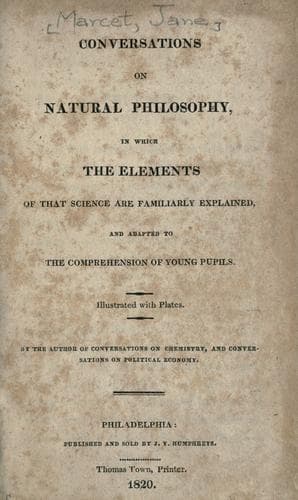
Conversations on Natural Philosophy, in which the Elements of that Science are Familiarly ExplainedMarcet, Mrs. (Jane Haldimand)
Science
Conversations on Natural Philosophy, in which the Elements of that Science are Familiarly Explained
Marcet, Mrs. (Jane Haldimand)
Physics
_Mrs. B._ When their wings are spread, this does not alter their weight,
but they are better supported by the air, as they cover a greater extent
of surface; yet they are still much too heavy to remain in that
situation, without continually flapping their wings, as you may have
noticed when birds hover over their nests: the force with which their
wings strike against the air, must equal the weight of their bodies, in
order that the reaction of the air, may be able to support that weight;
the bird will then remain stationary. If the stroke of the wings is
greater than is required merely to support the bird, the reaction of the
air will make it rise; if it be less, it will gently descend; and you
may have observed the lark, sometimes remaining with its wings extended,
but motionless; in this state it drops quietly into its nest.
_Caroline._ This is indeed a beautiful effect of the law of reaction!
But if flying is merely a mechanical operation, Mrs. B., why should we
not construct wings, adapted to the size of our bodies, fasten them to
our shoulders, move them with our arms, and soar into the air?
_Mrs. B._ Such an experiment has been repeatedly attempted, but never
with success; and it is now considered as totally impracticable. The
muscular power of birds, is incomparably greater in proportion to their
weight, than that of man; were we therefore furnished with wings
sufficiently large to enable us to fly, we should not have strength to
put them in motion.
In swimming, a similar action is produced on the water, to that on the
air, in flying; in rowing, also, you strike the water with the oars, in
a direction opposite to that in which the boat is required to move, and
it is the reaction of the water on the oars which drives the boat along.
_Emily._ You said, that it was in elastic bodies only, that the whole
motion of one body, would be communicated to another; pray what bodies
are elastic, besides the air?
_Mrs. B._ In speaking of the air, I think we defined elasticity to be a
property, by means of which bodies that are compressed, return to their
former state. If I bend this cane, as soon as I leave it at liberty, it
recovers its former position; if I press my finger upon your arm, as
soon as I remove it, the flesh, by virtue of its elasticity, rises and
destroys the impression I made. Of all bodies, the air is the most
eminent for this property, and it has thence obtained the name of an
elastic fluid. Hard bodies are in the next degree elastic; if two ivory,
or hardened steel balls are struck together, the parts at which they
touch, will be flattened; but their elasticity will make them
instantaneously resume their former shape.
_Caroline._ But when two ivory balls strike against each other, as they
constantly do on a billiard table, no mark or impression is made by the
stroke.
_Mrs. B._ I beg your pardon; you cannot, it is true, perceive any mark,
because their elasticity instantly destroys all trace of it.
Public-domain text, read in full here on John Shaqi.
Reviews
Reviews
No reviews yet
Be the first to share your thoughts on this work.
Join the Discussion
Join the discussion
Sign in to leave a comment or review.
Sign InorCreate an account