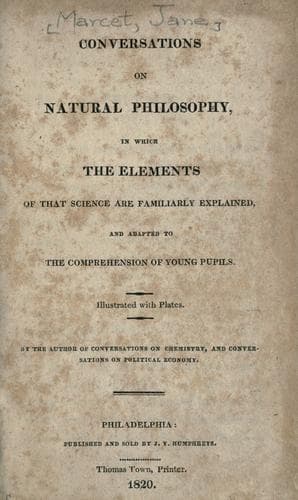
Conversations on Natural Philosophy, in which the Elements of that Science are Familiarly ExplainedMarcet, Mrs. (Jane Haldimand)
Science
Conversations on Natural Philosophy, in which the Elements of that Science are Familiarly Explained
Marcet, Mrs. (Jane Haldimand)
Physics
Soft bodies, which easily retain impressions, such as clay, wax, tallow,
butter, &c. have very little elasticity; but of all descriptions of
bodies, liquids are the least elastic.
_Emily._ If sealing-wax were elastic, instead of retaining the
impression of a seal, it would resume a smooth surface, as soon as the
weight of the seal was removed. But pray what is it that produces the
elasticity of bodies?
_Mrs. B._ There is great diversity of opinion upon that point, and I
cannot pretend to decide which approaches nearest to the truth.
Elasticity implies susceptibility of compression, and the susceptibility
of compression depends upon the porosity of bodies; for were there no
pores or spaces between the particles of matter of which a body is
composed, it could not be compressed.
_Caroline._ That is to say, that if the particles of bodies were as
close together as possible, they could not be squeezed closer.
_Emily._ Bodies then, whose particles are most distant from each other,
must be most susceptible of compression, and consequently most elastic;
and this you say is the case with air, which is perhaps the least dense
of all bodies?
_Mrs. B._ You will not in general find this rule hold good; for liquids
have scarcely any elasticity, whilst hard bodies are eminent for this
property, though the latter are certainly of much greater density than
the former; elasticity implies, therefore, not only a susceptibility of
compression, but depends upon the power possessed by the body, of
resuming its former state after compression, in consequence of the
peculiar arrangement of its particles.
_Caroline._ But surely there can be no pores in ivory and metals, Mrs.
B.; how then can they be susceptible of compression?
_Mrs. B._ The pores of such bodies are invisible to the naked eye, but
you must not thence conclude that they have none; it is, on the
contrary, well ascertained that gold, one of the most dense of all
bodies, is extremely porous; and that these pores are sufficiently large
to admit water when strongly compressed, to pass through them. This was
shown by a celebrated experiment made many years ago at Florence.
_Emily._ If water can pass through gold, there must certainly be pores
or interstices which afford it a passage; and if gold is so porous, what
must other bodies be, which are so much less dense than gold!
_Mrs. B._ The chief difference in this respect, is I believe, that the
pores in some bodies are larger than in others; in cork, sponge and
bread, they form considerable cavities; in wood and stone, when not
polished, they are generally perceptible to the naked eye; whilst in
ivory, metals, and all varnished and polished bodies, they cannot be
discerned. To give you an idea of the extreme porosity of bodies, sir
Isaac Newton conjectured that if the earth were so compressed as to be
absolutely without pores, its dimensions might possibly not be more than
a cubic inch.
Public-domain text, read in full here on John Shaqi.
Reviews
Reviews
No reviews yet
Be the first to share your thoughts on this work.
Join the Discussion
Join the discussion
Sign in to leave a comment or review.
Sign InorCreate an account