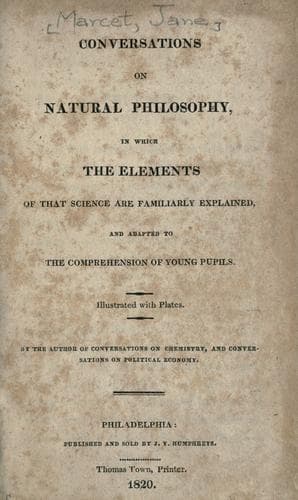
Conversations on Natural Philosophy, in which the Elements of that Science are Familiarly ExplainedMarcet, Mrs. (Jane Haldimand)
Science
Conversations on Natural Philosophy, in which the Elements of that Science are Familiarly Explained
Marcet, Mrs. (Jane Haldimand)
Physics
_Caroline._ What an idea! Were we not indebted to sir Isaac Newton for
the theory of attraction, I should be tempted to laugh at him for such a
supposition. What insignificant little creatures we should be!
_Mrs. B._ If our consequence arose from the size of our bodies, we
should indeed be but pigmies, but remember that the mind of Newton was
not circumscribed by the dimensions of its envelope.
_Emily._ It is, however, fortunate that heat keeps the pores of matter
open and distended, and prevents the attraction of cohesion from
squeezing us into a nut-shell.
_Mrs. B._ Let us now return to the subject of reaction, on which we have
some further observations to make. It is because reaction is in its
direction opposite to action, that _reflected motion_ is produced. If
you throw a ball against the wall, it rebounds; this return of the ball
is owing to the reaction of the wall against which it struck, and is
called _reflected motion_.
_Emily._ And I now understand why balls filled with air rebound better
than those stuffed with bran or wool; air being most susceptible of
compression and most elastic, the reaction is more complete.
_Caroline._ I have observed that when I throw a ball straight against
the wall, it returns straight to my hand; but if I throw it obliquely
upwards, it rebounds still higher, and I catch it when it falls.
_Mrs. B._ You should not say straight, but perpendicularly against the
wall; for straight is a general term for lines in all directions which
are neither curved nor bent, and is therefore equally applicable to
oblique or perpendicular lines.
_Caroline._ I thought that perpendicularly meant either directly upwards
or downwards?
_Mrs. B._ In those directions lines are perpendicular to the earth. A
perpendicular line has always a reference to something towards which it
is perpendicular; that is to say, that it inclines neither to the one
side or the other, but makes an equal angle on every side. Do you
understand what an angle is?
_Caroline._ Yes, I believe so: it is the space contained between two
lines meeting in a point.
_Mrs. B._ Well then, let the line A B (plate 2. fig. 1.) represent the
floor of the room, and the line C D that in which you throw a ball
against it; the line C D, you will observe, forms two angles with the
line A B, and those two angles are equal.
_Emily._ How can the angles be equal, while the lines which compose them
are of unequal length?
_Mrs. B._ An angle is not measured by the length of the lines, but by
their opening, or the space between them.
_Emily._ Yet the longer the lines are, the greater is the opening
between them.
_Mrs. B._ Take a pair of compasses and draw a circle over these spaces,
making the angular point the centre.
_Emily._ To what extent must I open the compasses?
Public-domain text, read in full here on John Shaqi.
Reviews
Reviews
No reviews yet
Be the first to share your thoughts on this work.
Join the Discussion
Join the discussion
Sign in to leave a comment or review.
Sign InorCreate an account