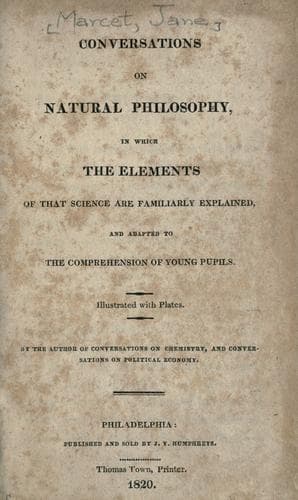
Conversations on Natural Philosophy, in which the Elements of that Science are Familiarly ExplainedMarcet, Mrs. (Jane Haldimand)
Science
Conversations on Natural Philosophy, in which the Elements of that Science are Familiarly Explained
Marcet, Mrs. (Jane Haldimand)
Physics
The screw, which is the last mechanical power, is more complicated than
the others. You will see by this figure, (fig. 9.) that it is composed
of two parts, the screw and the nut. The screw S is a cylinder, with a
spiral protuberance coiled round it, called the thread; the nut N is
perforated to receive the screw, and the inside of the nut has a spiral
groove, made to fit the spiral thread of the screw.
_Caroline._ It is just like this little box, the lid of which screws on
the box as you have described; but what is this handle L which projects
from the nut?
_Mrs. B._ It is a lever, which is attached to the nut, without which the
screw is never used as a mechanical power. The power of the screw,
complicated as it appears, is referable to one of the most simple of the
mechanical powers; which of them do you think it is?
_Caroline._ In appearance, it most resembles the wheel and axle.
_Mrs. B._ The lever, it is true, has the effect of a wheel, as it is the
means by which you turn the nut, or sometimes the screw, round; but the
lever is not considered as composing a part of the screw, though it is
true, that it is necessarily attached to it.
_Emily._ The spiral thread of the screw resembles, I think, an inclined
plane: it is a sort of slope, by means of which the nut ascends more
easily than it would do if raised perpendicularly; and it serves to
support it when at rest.
_Mrs. B._ Very well: if you cut a slip of paper in the form of an
inclined plane, and wind it round your pencil, which will represent the
cylinder, you will find that it makes a spiral line, corresponding to
the spiral protuberance of the screw. (Fig. 10.)
_Emily._ Very true; the nut then ascends an inclined plane, but ascends
it in a spiral, instead of a straight line: the closer the threads of
the screw, the more easy the ascent: it is like having shallow, instead
of steep steps to ascend.
_Mrs. B._ Yes; excepting that the nut takes no steps, as it gradually
winds up or down; then observe, that the closer the threads of the
screw, the less is its ascent in turning round, and the greater is its
power; so that we return to the old principle,--what is saved in power
is lost in time.
_Emily._ Cannot the power of the screw be increased also, by lengthening
the lever attached to the nut?
_Mrs. B._ Certainly. The screw, with the addition of the lever, forms a
very powerful machine, employed either for compression or to raise heavy
weights. It is used by book-binders, to press the leaves of books
together; it is used also in cider and wine presses, in coining, and for
a variety of other purposes.
_Emily._ Pray, Mrs. B., by what rule do you estimate the power of the
screw?
Public-domain text, read in full here on John Shaqi.
Reviews
Reviews
No reviews yet
Be the first to share your thoughts on this work.
Elsewhere in the archive
Join the Discussion
Join the discussion
Sign in to leave a comment or review.
Sign InorCreate an account