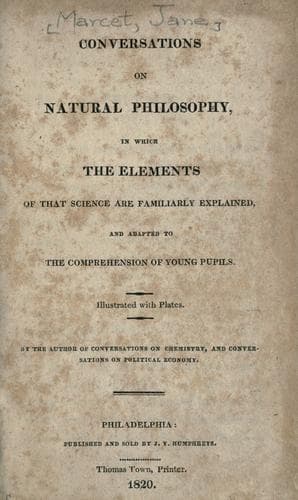
Conversations on Natural Philosophy, in which the Elements of that Science are Familiarly ExplainedMarcet, Mrs. (Jane Haldimand)
Science
Conversations on Natural Philosophy, in which the Elements of that Science are Familiarly Explained
Marcet, Mrs. (Jane Haldimand)
Physics
_Mrs. B._ By measuring the circumference of the circle, which the end of
the lever would form in one whole revolution, and comparing this with
the distance from the centre of one thread of the screw, to that of its
next contiguous turn; for whilst the lever travels that whole distance,
the screw rises or falls only through the distance from one coil to
another.
_Caroline._ I think that I have sometimes seen the lever attached to the
screw, and not to the nut, as it is represented in the figure.
_Mrs. B._ This is frequently done, but it does not in any degree affect
the power of the instrument.
All machines are composed of one or more of these six mechanical powers
we have examined; I have but one more remark to make to you relative to
them, which is, that friction in a considerable degree diminishes their
force: allowance must therefore always be made for it, in the
construction of machinery.
_Caroline._ By friction, do you mean one part of the machine rubbing
against another part contiguous to it?
_Mrs. B._ Yes; friction is the resistance which bodies meet with in
rubbing against each other; there is no such thing as perfect smoothness
or evenness in nature; polished metals, though they wear that appearance
more than most other bodies, are far from really possessing it; and
their inequalities may frequently be perceived through a good magnifying
glass. When, therefore, the surfaces of the two bodies come in contact,
the prominent parts of the one, will often fall into the hollow parts of
the other, and occasion more or less resistance to motion.
_Caroline._ But if a machine is made of polished metal, as a watch for
instance, the friction must be very trifling?
_Mrs. B._ In proportion as the surfaces of bodies are well polished, the
friction is doubtless diminished; but it is always considerable, and it
is usually computed to destroy one-third of the power of a machine. Oil
or grease is used to lessen friction: it acts as a polish, by filling up
the cavities of the rubbing surfaces, and thus making them slide more
easily over each other.
_Caroline._ Is it for this reason that wheels are greased, and the locks
and hinges of doors oiled?
_Mrs. B._ Yes; in these instances the contact of the rubbing surfaces is
so close, and they are so constantly in use, that they require to be
frequently oiled, or a considerable degree of friction is produced.
Public-domain text, read in full here on John Shaqi.
Reviews
Reviews
No reviews yet
Be the first to share your thoughts on this work.
Elsewhere in the archive
Join the Discussion
Join the discussion
Sign in to leave a comment or review.
Sign InorCreate an account