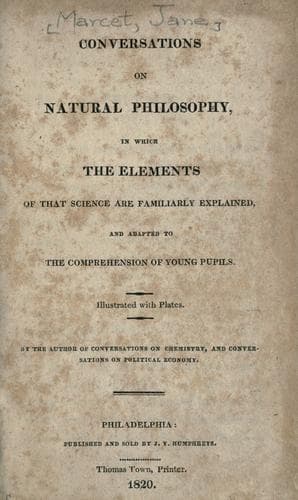
Conversations on Natural Philosophy, in which the Elements of that Science are Familiarly ExplainedMarcet, Mrs. (Jane Haldimand)
Science
Conversations on Natural Philosophy, in which the Elements of that Science are Familiarly Explained
Marcet, Mrs. (Jane Haldimand)
Physics
_Emily._ I make no doubt of it, Mrs. B.; and pray begin by explaining
why the earth requires no support; for that is the point which just now
most strongly excites my curiosity.
_Mrs. B._ My dear Emily, if I am to attempt to give you a general idea
of the laws of nature, which is no less than to introduce you to a
knowledge of the science of natural philosophy, it will be necessary for
us to proceed with some degree of regularity. I do not wish to confine
you to the systematic order of a scientific treatise, but if we were
merely to examine every vague question that may chance to occur, our
progress would be but very slow. Let us, therefore, begin by taking a
short survey of the general properties of bodies, some of which must
necessarily be explained before I can attempt to make you understand why
the earth requires no support.
When I speak of _bodies_, I mean substances, of whatever nature, whether
solid or fluid; and _matter_ is the general term used to denote the
substance, whatever its nature be, of which the different bodies are
composed. Thus, the wood of which this table is made, the water with
which this glass is filled, and the air which we continually breathe,
are each of them _matter_.
_Emily._ I am very glad you have explained the meaning of the word
matter, as it has corrected an erroneous conception I had formed of it:
I thought that it was applicable to solid bodies only.
_Mrs. B._ There are certain properties which appear to be common to all
bodies, and are hence called the _essential or inherent properties_ of
bodies; these are _Impenetrability_, _Extension_, _Figure_,
_Divisibility_, _Inertia_ and _Attraction_. These are also called the
general properties of bodies, as we do not suppose any body to exist
without them.
By _impenetrability_ is meant the property which bodies have of
occupying a certain space, so that where one body is, another can not
be, without displacing the former; for two bodies can not exist in the
same place at the same time. A liquid may be more easily removed than a
solid body; yet it is not the less substantial, since it is as
impossible for a liquid and a solid to occupy the same space at the same
time, as for two solid bodies to do so. For instance, if you put a spoon
into a glass full of water, the water will flow over to make room for
the spoon.
_Emily._ I understand this perfectly. Liquids are in reality as
substantial or as impenetrable as solid bodies, and they appear less so,
only because they are more easily displaced.
Public-domain text, read in full here on John Shaqi.
Reviews
Reviews
No reviews yet
Be the first to share your thoughts on this work.
Join the Discussion
Join the discussion
Sign in to leave a comment or review.
Sign InorCreate an account