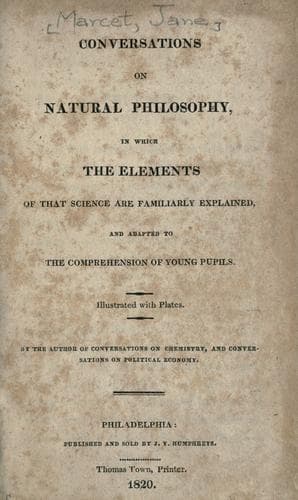
Conversations on Natural Philosophy, in which the Elements of that Science are Familiarly Explained — John Shaqi
Conversations on Natural Philosophy, in which the Elements of that Science are Familiarly ExplainedMarcet, Mrs. (Jane Haldimand)
Science
Conversations on Natural Philosophy, in which the Elements of that Science are Familiarly Explained
Marcet, Mrs. (Jane Haldimand)
Physics
_Mrs. B._ The air is a fluid differing in its nature from liquids, but
no less impenetrable. If I endeavour to fill this phial by plunging it
into this bason of water, the air, you see, rushes out of the phial in
bubbles, in order to make way for the water, for the air and the water
can not exist together in the same space, any more than two hard bodies;
and if I reverse this goblet, and plunge it perpendicularly into the
water, so that the air will not be able to escape, the water will no
longer be able to fill the goblet.
_Emily._ But it rises some way into the glass.
_Mrs. B._ Because the water compresses or squeezes the air into a
smaller space in the upper part of the glass; but, as long as it remains
there, no other body can occupy the same place.
_Emily._ A difficulty has just occurred to me, with regard to the
impenetrability of solid bodies; if a nail is driven into a piece of
wood, it penetrates it, and both the wood and the nail occupy the same
space that the wood alone did before?
_Mrs. B._ The nail penetrates between the particles of the wood, by
forcing them to make way for it; for you know that not a single atom of
wood can remain in the space which the nail occupies; and if the wood is
not increased in size by the addition of the nail, it is because wood is
a porous substance, like sponge, the particles of which may be
compressed or squeezed closer together; and it is thus that they make
way for the nail.
We may now proceed to the next general property of bodies, _extension_.
A body which occupies a certain space must necessarily have extension;
that is to say, _length_, _breadth_ and _depth_ or thickness; these are
called the dimensions of extension: can you form an idea of any body
without them?
_Emily._ No; certainly I can not; though these dimensions must, of
course vary extremely in different bodies. The length, breadth and depth
of a box, or of a thimble, are very different from those of a walking
stick, or of a hair.
But is not height also a dimension of extension?
_Mrs B._ Height and depth are the same dimension, considered in
different points of view; if you measure a body, or a space, from the
top to the bottom, you call it depth; if from the bottom upwards, you
call it height; thus the depth and height of a box are, in fact, the
same thing.
_Emily._ Very true; a moment's consideration would have enabled me to
discover that; and breadth and width are also the same dimension.
_Mrs. B._ Yes; the limits of extension constitute _figure_ or shape. You
conceive that a body having length, breadth and depth, can not be
without form, either symmetrical or irregular?
_Emily._ Undoubtedly; and this property admits of almost an infinite
variety.
Public-domain text, read in full here on John Shaqi.
Reviews
Reviews
No reviews yet
Be the first to share your thoughts on this work.
Join the Discussion
Join the discussion
Sign in to leave a comment or review.
Sign InorCreate an account