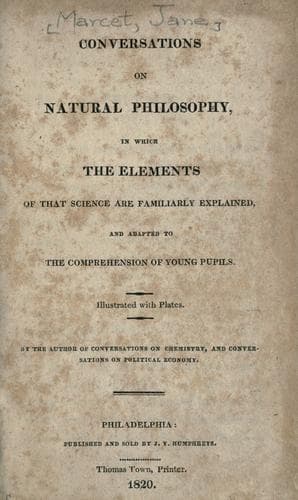
Conversations on Natural Philosophy, in which the Elements of that Science are Familiarly ExplainedMarcet, Mrs. (Jane Haldimand)
Science
Conversations on Natural Philosophy, in which the Elements of that Science are Familiarly Explained
Marcet, Mrs. (Jane Haldimand)
Physics
There are two kinds of friction; the first is occasioned by the rubbing
of the surfaces of bodies against each other, the second, by the rolling
of a circular body; as that of a carriage wheel upon the ground: the
friction resulting from the first is much the most considerable, for
great force is required to enable the sliding body to overcome the
resistance which the asperities of the surfaces in contact oppose to its
motion, and it must be either lifted over, or break through them;
whilst, in the second kind of friction, the rough parts roll over each
other with comparative facility; hence it is, that wheels are often used
for the sole purpose of diminishing the resistance from friction.
_Emily._ This is one of the advantages of carriage wheels, is it not?
_Mrs. B._ Yes; and the larger the circumference of the wheel the more
readily it can overcome any considerable obstacles, such as stones, or
inequalities in the road. When, in descending a steep hill, we fasten
one of the wheels, we decrease the velocity of the carriage, by
increasing the friction.
_Caroline._ That is to say, by converting the rolling friction into the
rubbing friction. And when you had casters put to the legs of the table,
in order to move it more easily, you changed the rubbing into the
rolling friction.
_Mrs. B._ There is another circumstance which we have already noticed,
as diminishing the motion of bodies, and which greatly affects the
power of machines. This is the resistance of the medium, in which a
machine is worked. All fluids, whether elastic like air, or non-elastic
like water and other liquids, are called mediums; and their resistance
is proportioned to their density; for the more matter a body contains,
the greater the resistance it will oppose to the motion of another body
striking against it.
_Emily._ It would then be much more difficult to work a machine under
water than in the air?
_Mrs. B._ Certainly, if a machine could be worked in _vacuo_, and
without friction, it would not be impeded, but this is unattainable; a
considerable reduction of power must therefore be allowed for, from
friction and the resistance of the medium.
We shall here conclude our observations on the mechanical powers. At our
next meeting I shall endeavour to give you an explanation of the motion
of the heavenly bodies.
Questions
31. (Pg. 62) Describe a pulley, and its use.
32. (Pg. 62) What is meant by a fixed pulley and why is not power gained
by its employment? (fig. 1. plate 5.)
33. (Pg. 62) Of what use is the fixed pulley?
34. (Pg. 63) How is the power gained by a moveable pulley, explained by
means of fig. 2. plate 5?
35. (Pg. 63) What proportion must the power bear to the weight in fig.
2, that their momentums may be equal?
36. (Pg. 64) What is a fundamental law as respects power and time?
37. (Pg. 64) If to gain power we must lose time, what advantage do we
derive from the mechanical powers?
Public-domain text, read in full here on John Shaqi.
Reviews
Reviews
No reviews yet
Be the first to share your thoughts on this work.
Elsewhere in the archive
Join the Discussion
Join the discussion
Sign in to leave a comment or review.
Sign InorCreate an account