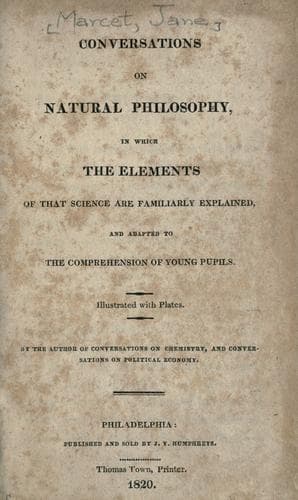
Conversations on Natural Philosophy, in which the Elements of that Science are Familiarly ExplainedMarcet, Mrs. (Jane Haldimand)
Science
Conversations on Natural Philosophy, in which the Elements of that Science are Familiarly Explained
Marcet, Mrs. (Jane Haldimand)
Physics
_Emily._ Then, since the earth moves with the greatest velocity in that
part of its orbit in which it is nearest the sun, it must have completed
its journey through that half of its orbit, in a shorter time than
through the other?
_Mrs. B._ Yes, it is about seven days longer performing the summer-half
of its orbit, than the winter-half; and the summers are consequently
seven days longer in the northern, than they are in the southern
hemisphere.
The revolution of all the planets round the sun, is the result of the
same causes, and is performed in the same manner, as that of the earth.
_Caroline._ Pray what are the planets?
_Mrs. B._ They are those celestial bodies, which revolve like our earth,
about the sun; they are supposed to resemble the earth also in many
other respects; and we are led by analogy, to suppose them to be
inhabited worlds.
_Caroline._ I have heard so, but do you not think such an opinion too
great a stretch of the imagination?
_Mrs. B._ Some of the planets are proved to be larger than the earth; it
is only their immense distance from us, which renders their apparent
dimensions so small. Now, if we consider them as enormous globes,
instead of small twinkling spots, we shall be led to suppose that the
Almighty would not have created them merely for the purpose of giving us
a little light in the night, as it was formerly imagined; and we should
find it more consistent with our ideas of the Divine wisdom and
beneficence, to suppose that these celestial bodies should be created
for the habitation of beings, who are, like us, blessed by his
providence. Both in a moral, as well as a physical point of view, it
appears to me more rational to consider the planets as worlds revolving
round the sun; and the fixed stars as other suns, each of them attended
by their respective system of planets, to which they impart their
influence. We have brought our telescopes to such a degree of
perfection, that from the appearances which the moon exhibits when seen
through them, we have very good reason to conclude that it is a
habitable globe: for though it is true that we cannot discern its towns
and people, we can plainly perceive its mountains and valleys: and some
astronomers have gone so far as to imagine that they discovered
volcanos.
_Emily._ If the fixed stars are suns, with planets revolving round them,
why should we not see those planets as well as their suns?
_Mrs. B._ In the first place, we conclude that the planets of other
systems (like those of our own) are much smaller than the suns which
give them light; therefore at a distance so great as to make the suns
appear like fixed stars, the planets would be quite invisible. Secondly,
the light of the planets being only reflected light, is much more feeble
than that of the fixed stars. There is exactly the same difference as
between the light of the sun and that of the moon; the first being a
fixed star, the second a planet.
Public-domain text, read in full here on John Shaqi.
Reviews
Reviews
No reviews yet
Be the first to share your thoughts on this work.
Elsewhere in the archive
Join the Discussion
Join the discussion
Sign in to leave a comment or review.
Sign InorCreate an account