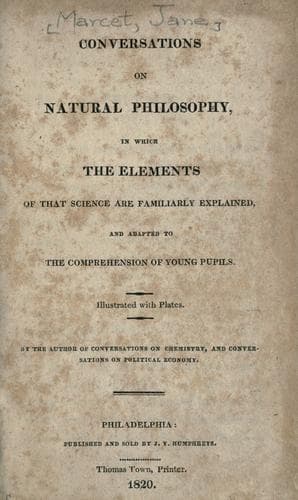
Conversations on Natural Philosophy, in which the Elements of that Science are Familiarly ExplainedMarcet, Mrs. (Jane Haldimand)
Science
Conversations on Natural Philosophy, in which the Elements of that Science are Familiarly Explained
Marcet, Mrs. (Jane Haldimand)
Physics
_Emily._ But the planets appear to us as bright as the fixed stars, and
these you tell us are suns like our own; why then do we not see them by
daylight, when they must be just as luminous as they are in the night?
_Mrs. B._ Both are invisible from the same cause: their light is so
faint, compared to that of the sun, that it is entirely effaced by it:
the light emitted by the fixed stars may probably be as great as that of
our sun, at an equal distance; but they being so much more remote, it
is diffused over a greater space, and is in consequence proportionally
lessened.
_Caroline._ True; I can see much better by the light of a candle that is
near me, than by that of one at a great distance. But I do not
understand what makes the planets shine?
_Mrs. B._ What is that which makes the gilt buttons on your brothers
coat shine?
_Caroline._ The sun. But if it was the sun which made the planets shine,
we should see them in the day-time, when the sun shone upon them; or if
the faintness of their light prevented our seeing them in the day, we
should not see them at all, for the sun cannot shine upon them in the
night.
_Mrs. B._ There you are in error. But in order to explain this to you, I
must first make you acquainted with the various motions of the planets.
You know, that according to the laws of attraction, the planets
belonging to our system all gravitate towards the sun; and that this
force, combined with that of projection, will occasion their revolution
round the sun, in orbits more or less elliptical, according to the
proportion which these two forces bear to each other.
But the planets have also another motion: they revolve upon their axis.
The axis of a planet is an imaginary line which passes through its
centre, and on which it turns; and it is this motion which produces day
and night. It is day on that side of the planet which faces the sun; and
on the opposite side, which remains in darkness, it is night. Our earth,
which we consider as a planet, is 24 hours in performing one revolution
on its axis; in that period of time, therefore, we have a day and a
night; hence this revolution is called the earth's diurnal or daily
motion; and it is this revolution of the earth from west to east which
produces an apparent motion of the sun, moon and stars, in a contrary
direction.
Let us now suppose ourselves to be beings independent of any planet,
travelling in the skies, and looking upon the earth from a point as
distant from it as from other planets.
_Caroline._ It would not be flattering to us, its inhabitants, to see it
make so insignificant an appearance.
Public-domain text, read in full here on John Shaqi.
Reviews
Reviews
No reviews yet
Be the first to share your thoughts on this work.
Elsewhere in the archive
Join the Discussion
Join the discussion
Sign in to leave a comment or review.
Sign InorCreate an account