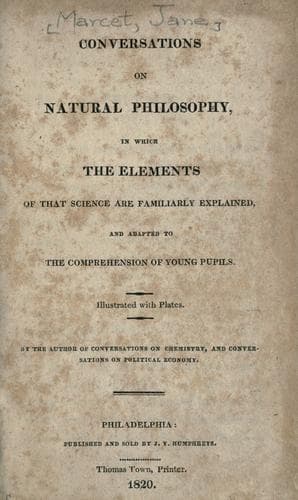
Conversations on Natural Philosophy, in which the Elements of that Science are Familiarly ExplainedMarcet, Mrs. (Jane Haldimand)
Science
Conversations on Natural Philosophy, in which the Elements of that Science are Familiarly Explained
Marcet, Mrs. (Jane Haldimand)
Physics
_Mrs. B._ To those accustomed to contemplate it in this light, it could
never appear more glorious. We are taught by science to distrust
appearances; and instead of considering the fixed stars and planets as
little points, we look upon them either as brilliant suns, or habitable
worlds; and we consider the whole together as forming one vast and
magnificent system, worthy of the Divine hand by which it was created.
_Emily._ I can scarcely conceive the idea of this immensity of creation;
it seems too sublime for our imagination;--and to think that the
goodness of Providence extends over millions of worlds throughout a
boundless universe--Ah! Mrs. B., it is we only who become trifling and
insignificant beings in so magnificent a creation!
_Mrs. B._ This idea should teach us humility, but without producing
despondency. The same Almighty hand which guides these countless worlds
in their undeviating course, conducts with equal perfection, the blood
as it circulates through the veins of a fly, and opens the eye of the
insect to behold His wonders. Notwithstanding this immense scale of
creation, therefore, we need not fear that we shall be disregarded or
forgotten.
But to return to our station in the skies. We were, if you recollect,
viewing the earth at a great distance, in appearance a little star, one
side illumined by the sun, the other in obscurity. But would you believe
it, Caroline, many of the inhabitants of this little star imagine that
when that part which they inhabit is turned from the sun, darkness
prevails throughout the universe, merely because it is night with them;
whilst, in reality, the sun never ceases to shine upon every planet.
When, therefore, these little ignorant beings look around them during
their night, and behold all the stars shining, they cannot imagine why
the planets, which are dark bodies, should shine; concluding, that since
the sun does not illumine themselves, the whole universe must be in
darkness.
_Caroline._ I confess that I was one of these ignorant people; but I am
now very sensible of the absurdity of such an idea. To the inhabitants
of the other planets, then, we must appear as a little star?
_Mrs. B._ Yes, to those which revolve round our sun; for since those
which may belong to other systems, (and whose existence is only
hypothetical) are invisible to us, it is probable that we also are
invisible to them.
_Emily._ But they may see our sun as we do theirs, in appearance a fixed
star?
_Mrs. B._ No doubt; if the beings who inhabit those planets are endowed
with senses similar to ours. By the same rule we must appear as a moon
to the inhabitants of our moon; but on a larger scale, as the surface of
the earth is about thirteen times as large as that of the moon.
_Emily._ The moon, Mrs. B., appears to move in a different direction,
and in a different manner from the stars?
Public-domain text, read in full here on John Shaqi.
Reviews
Reviews
No reviews yet
Be the first to share your thoughts on this work.
Elsewhere in the archive
Join the Discussion
Join the discussion
Sign in to leave a comment or review.
Sign InorCreate an account