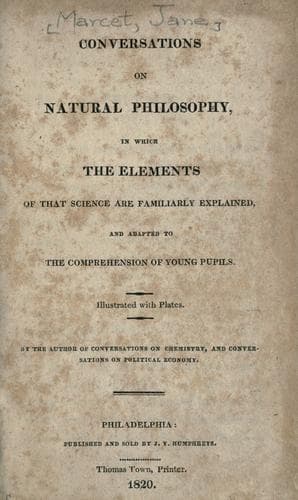
Conversations on Natural Philosophy, in which the Elements of that Science are Familiarly ExplainedMarcet, Mrs. (Jane Haldimand)
Science
Conversations on Natural Philosophy, in which the Elements of that Science are Familiarly Explained
Marcet, Mrs. (Jane Haldimand)
Physics
_Mrs. B._ I shall defer the explanation of the motion of the moon till
our next interview, as it would prolong our present lesson too much.
Questions
1. (Pg. 71) What revolution does the earth perform in a year?
2. (Pg. 71) Had the earth received a projectile force only, at the time
of its creation, how would it have moved?
3. (Pg. 72) What do the lines A B, and A C, represent in fig. 1. plate
6?
4. (Pg. 72) What have you been taught respecting a body acted upon by
two forces at right angles with each other?
5. (Pg. 72) How does the force of gravity change the diagonal into a
curved line?
6. (Pg. 72) Describe the operation of the forces of projection and of
gravity as illustrated by the parallelograms in the figure?
7. (Pg. 72) What is the law respecting the time required for motion in
the diagonal?
8. (Pg. 73) What portion of a year is represented by the three diagonals
in the figure?
9. (Pg. 73) How will what you have learned respecting motion in a curve,
apply to the earth's motion?
10. (Pg. 73) In what form are you directed to cut a piece of card to aid
in illustrating the two forces acting upon the earth?
11. (Pg. 73) How must you apply it to this purpose? (fig. 2. plate 6.)
12. (Pg. 73) If these two forces did not exactly balance each other,
what would result?
13. (Pg. 73) Does the earth revolve in a circular orbit?
14. (Pg. 73) What results from its motion in an ellipsis?
15. (Pg. 74) What is represented by the lines A C, A B, in fig. 3. plate
6?
16. (Pg. 74) Were the projectile force to carry the earth from B to D,
(fig. 3.) what would result?
17. (Pg. 74) When it has arrived at E, what angle will be formed by the
lines representing the two forces?
18. (Pg. 74) What effect will the accelerated motion then produce?
19. (Pg. 75) What is the form of the earth's orbit, and what
circumstances produce this form?
20. (Pg. 75) What is the consequence as regards the regularity of the
earth's motion?
21. (Pg. 75) What law governs as regards the spaces passed over, and how
is this explained by fig. 4. plate 6?
22. (Pg. 75) What is meant by _perihelion_, and by _aphelion_?
23. (Pg. 75) What is the difference of the distance of the earth from
the sun, in these two points?
24. (Pg. 76) At what season of the year is it nearest to, and at what
furthest from the sun?
25. (Pg. 76) What is the mean distance of the earth from the sun?
26. (Pg. 76) Why is but little effect produced, as regards temperature,
by the change of distance?
27. (Pg. 76) Has it any influence on the sun's apparent size?
28. (Pg. 76) Are the summer and winter, half years, of the same length;
what is their difference, and what is the cause?
29. (Pg. 76) What are the planets?
30. (Pg. 77) What circumstances render it probable that they are
habitable globes?
31. (Pg. 77) What is believed respecting the fixed stars?
32. (Pg. 77) What discoveries have been made in the moon?
Public-domain text, read in full here on John Shaqi.
Reviews
Reviews
No reviews yet
Be the first to share your thoughts on this work.
Elsewhere in the archive
Join the Discussion
Join the discussion
Sign in to leave a comment or review.
Sign InorCreate an account