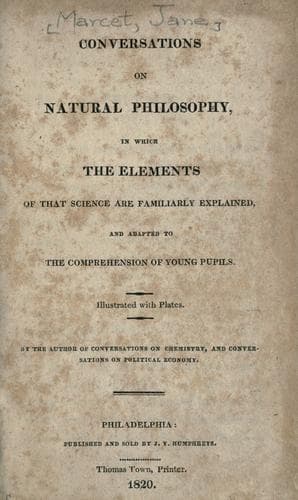
Conversations on Natural Philosophy, in which the Elements of that Science are Familiarly ExplainedMarcet, Mrs. (Jane Haldimand)
Science
Conversations on Natural Philosophy, in which the Elements of that Science are Familiarly Explained
Marcet, Mrs. (Jane Haldimand)
Physics
33. (Pg. 77) What prevents our seeing the planets, if there are any,
which revolve round the fixed stars?
34. (Pg. 77) What prevents our seeing the stars and planets in the
day-time?
35. (Pg. 78) What other motions have the earth and planets, besides that
in their orbits?
36. (Pg. 78) What is the imaginary line called, round which they
revolve?
37. (Pg. 78) How does this occasion night and day?
38. (Pg. 78) In what direction does the earth turn upon its axis, and
what apparent motion of the sun, moon, and stars is thereby produced?
39. (Pg. 79) What must be the appearance of the earth to an inhabitant
of one of the planets?
40. (Pg. 79) What the appearance of the sun to the inhabitants of
planets in other systems?
41. (Pg. 79) What the appearance of the earth to an inhabitant of the
moon?
CONVERSATION VII.
OF THE PLANETS.
OF THE SATELLITES OR MOONS. GRAVITY DIMINISHES AS THE SQUARE OF THE
DISTANCE. OF THE SOLAR SYSTEM. OF COMETS. CONSTELLATIONS, SIGNS OF THE
ZODIAC. OF COPERNICUS, NEWTON, &c.
MRS. B.
The planets are distinguished into primary and secondary. Those which
revolve immediately about the sun are called primary. Many of these are
attended in their course by smaller planets, which, revolve round them:
these are called secondary planets, satellites, or moons. Such is our
moon which accompanies the earth, and is carried with it round the sun.
_Emily._ How then can you reconcile the motion of the secondary planets
to the laws of gravitation; for the sun is much larger than any of the
primary planets; and is not the power of gravity proportional to the
quantity of matter?
_Caroline._ Perhaps the sun, though much larger, may be less dense than
the planets. Fire you know, is very light, and it may contain but little
matter, though of great magnitude.
_Mrs. B._ We do not know of what kind of matter the sun is made; but we
may be certain, that since it is the general centre of attraction of our
system of planets, it must be the body which contains the greatest
quantity of matter in that system.
You must recollect, that the force of attraction is not only
proportional to the quantity of matter, but to the degree of proximity
of the attractive body: this power is weakened by being diffused, and
diminishes as the distance increases.
_Emily._ Then if a planet was to lose one-half of its quantity of
matter, it would lose one half of its attractive power; and the same
effect would be produced by removing it to twice its former distance
from the sun; that I understand.
_Mrs. B._ Not so perfectly as you imagine. You are correct as respects
the diminution in size, because the attractive force is in the same
proportion as the quantity of matter; but were you to remove a planet to
double its former distance, it would retain but one-fourth part of its
gravitating force; for attraction decreases not in proportion to the
simple increase of the distance, but as the squares of the distances
increase.
Public-domain text, read in full here on John Shaqi.
Reviews
Reviews
No reviews yet
Be the first to share your thoughts on this work.
Elsewhere in the archive
Join the Discussion
Join the discussion
Sign in to leave a comment or review.
Sign InorCreate an account