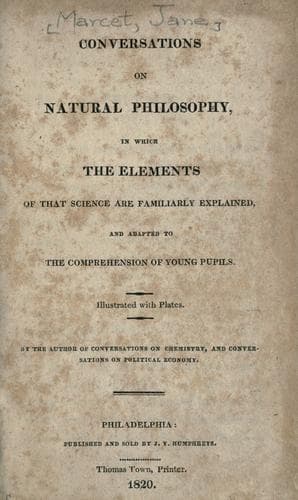
Conversations on Natural Philosophy, in which the Elements of that Science are Familiarly ExplainedMarcet, Mrs. (Jane Haldimand)
Science
Conversations on Natural Philosophy, in which the Elements of that Science are Familiarly Explained
Marcet, Mrs. (Jane Haldimand)
Physics
_Caroline._ I do not exactly comprehend what is meant by the squares, in
this case, although I know very well what is in general intended by a
square.
_Mrs. B._ By the square of a number we mean the product of a number,
multiplied by itself; thus two, multiplied by two, is four, which is
therefore the square of two; in like manner the square of three, is
nine, because three multiplied by three, gives that product.
_Emily._ Then if one planet is three times more distant from the sun
than another, it will be attracted with but one-ninth part of the force;
and if at four times the distance, with but one-sixteenth, sixteen being
the square of four?
_Mrs. B._ You are correct; the rule is, that _the attractive force is in
the inverse proportion of the square of the distance_. And it is easily
demonstrated by the mathematics, that the same is the case with every
power that emanates from a centre; as for example, the light from the
sun, or from any other luminous body, decreases in its intensity at the
same rate.
_Caroline._ Then the more distant planets, move much slower in their
orbits; for their projectile force must be proportioned to that of
attraction? But I do not see how this accounts for the motion of the
secondary, round the primary planets, in preference to moving round the
sun?
_Emily._ Is it not because the vicinity of the primary planets, renders
their attraction stronger than that of the sun?
_Mrs. B._ Exactly so. But since the attraction between bodies is
mutual, the primary planets are also attracted by the satellites which
revolve round them. The moon attracts the earth, as well as the earth
the moon; but as the latter is the smaller body, her attraction is
proportionally less; therefore, neither the earth revolves round the
moon, nor the moon round the earth; but they both revolve round a point,
which is their common centre of gravity, and which is as much nearer to
the earth than to the moon, as the gravity of the former exceeds that of
the latter.
_Emily._ Yes, I recollect your saying, that if two bodies were fastened
together by a wire or bar, their common centre of gravity would be in
the middle of the bar, provided the bodies were of equal weight; and if
they differed in weight, it would be nearer the larger body. If then,
the earth and moon had no projectile force which prevented their mutual
attraction from bringing them together, they would meet at their common
centre of gravity.
_Caroline._ The earth then has a great variety of motion, it revolves
round the sun, round its own axis, and round the point towards which the
moon attracts it.
_Mrs. B._ Just so; and this is the case with every planet which is
attended by satellites. The complicated effect of this variety of
motions, produces certain irregularities, which, however, it is not
necessary to notice at present, excepting to observe that they
eventually correct each other, so that no permanent derangement exists.
Public-domain text, read in full here on John Shaqi.
Reviews
Reviews
No reviews yet
Be the first to share your thoughts on this work.
Elsewhere in the archive
Join the Discussion
Join the discussion
Sign in to leave a comment or review.
Sign InorCreate an account