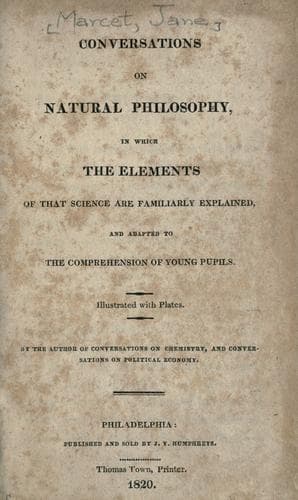
Conversations on Natural Philosophy, in which the Elements of that Science are Familiarly ExplainedMarcet, Mrs. (Jane Haldimand)
Science
Conversations on Natural Philosophy, in which the Elements of that Science are Familiarly Explained
Marcet, Mrs. (Jane Haldimand)
Physics
The planets act on the sun, in the same manner as they are themselves
acted on by their satellites; for attraction, you must remember, is
always mutual; but the gravity of the planets (even when taken
collectively) is so trifling compared with that of the sun, that were
they all placed on the same side of that luminary, they would not cause
him to move so much as one-half of his diameter towards them, and the
common centre of gravity, would still remain within the body of the sun.
The planets do not, therefore, revolve round the centre of the sun, but
round a point at a small distance from its centre, about which the sun
also revolves.
_Emily._ I thought the sun had no motion?
_Mrs. B._ You were mistaken; for besides that round the common centre of
gravity, which I have just mentioned, which is indeed very
inconsiderable, he revolves on his axis in about 25 days; this motion is
ascertained by observing certain spots which disappear, and reappear
regularly at stated times.
[Illustration: PLATE VII.]
_Caroline._ A planet has frequently been pointed out to me in the
heavens; but I could not perceive that its motion differed from that of
the fixed stars, which only appear to move.
_Mrs. B._ The great distance of the planets, renders their apparent
motion so slow, that the eye is not sensible of their progress in their
orbits, unless we watch them for some considerable length of time: but
if you notice the nearness of a planet to any particular fixed star, you
may in a few nights perceive that it has changed its distance from it,
whilst the stars themselves always retain their relative situations. The
most accurate idea I can give you of the situation and motion of the
planets in their orbits, will be by the examination of this diagram,
(plate 7. fig. 1.) representing the solar system, in which you will find
every planet, with its orbit delineated.
_Emily._ But the orbits here are all circular, and you said that they
were elliptical. The planets appear too, to be moving round the centre
of the sun; whilst you told us that they moved round a point at a little
distance from thence.
_Mrs. B._ The orbits of the planets are so nearly circular, and the
common centre of gravity of the solar system, so near the centre of the
sun, that these deviations are too small to be represented. The
dimensions of the planets, in their proportion to each other, you will
find delineated in fig. 2.
Public-domain text, read in full here on John Shaqi.
Reviews
Reviews
No reviews yet
Be the first to share your thoughts on this work.
Elsewhere in the archive
Join the Discussion
Join the discussion
Sign in to leave a comment or review.
Sign InorCreate an account