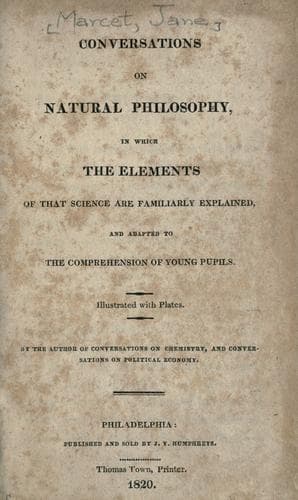
Conversations on Natural Philosophy, in which the Elements of that Science are Familiarly ExplainedMarcet, Mrs. (Jane Haldimand)
Science
Conversations on Natural Philosophy, in which the Elements of that Science are Familiarly Explained
Marcet, Mrs. (Jane Haldimand)
Physics
Mercury is the planet nearest the sun; his orbit is consequently
contained within ours; his vicinity to the sun, prevents our frequently
seeing him, so that very accurate observations cannot be made upon
Mercury. He performs his revolution round the sun in about 87 days,
which is consequently the length of his year. The time of his rotation
on his axis is not known; his distance from the sun is computed to be 37
millions of miles, and his diameter 3180 miles. The heat of this planet
is supposed to be so great, that water cannot exist there but in a state
of vapour, and that even quicksilver would be made to boil.
_Caroline._ Oh, what a dreadful climate!
_Mrs. B._ Though we could not live there, it may be perfectly adapted to
other beings, destined to inhabit it; or he who created it may have so
modified the heat, by provisions of which we are ignorant, as to make it
habitable even by ourselves.
Venus, the next in the order of planets, is 68 millions of miles from
the sun: she revolves about her axis in 23 hours and 21 minutes, and
goes round the sun in 244 days, 17 hours. The orbit of Venus is also
within ours; during nearly one-half of her course in it, we see her
before sun-rise, and she is then called the morning star; in the other
part of her orbit she rises later than the sun.
_Caroline._ In that case we cannot see her, for she must rise in the day
time?
_Mrs. B._ True; but when she rises later than the sun, she also sets
later; so that we perceive her approaching the horizon after sun-set:
she is then called Hesperus, or the evening star. Do you recollect those
beautiful lines of Milton?
Now came still evening on, and twilight gray
Had in her sober livery all things clad;
Silence accompanied; for beast and bird,
They to their grassy couch, these to their nests
Were slunk, all but the wakeful nightingale;
She all night long her amorous descant sung;
Silence was pleas'd; now glowed the firmament
With living sapphires. Hesperus that led
The starry host, rode brightest, till the moon
Rising in clouded majesty, at length
Apparent queen unveil'd her peerless light,
And o'er the dark her silver mantle threw.
The planet next to Venus is the Earth, of which we shall soon speak at
full length. At present I shall only observe that we are 95 millions of
miles distant from the sun, that we perform our annual revolution in 365
days 5 hours and 49 minutes; and are attended in our course by a single
moon.
Public-domain text, read in full here on John Shaqi.
Reviews
Reviews
No reviews yet
Be the first to share your thoughts on this work.
Elsewhere in the archive
Join the Discussion
Join the discussion
Sign in to leave a comment or review.
Sign InorCreate an account