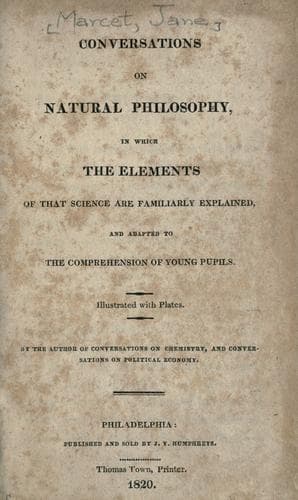
Conversations on Natural Philosophy, in which the Elements of that Science are Familiarly ExplainedMarcet, Mrs. (Jane Haldimand)
Science
Conversations on Natural Philosophy, in which the Elements of that Science are Familiarly Explained
Marcet, Mrs. (Jane Haldimand)
Physics
Next follows Mars. He can never come between us and the sun, like
Mercury and Venus; his motion is, however, very perceptible, as he may
be traced to different situations in the heavens; his distance from the
sun is 144 millions of miles; he turns round his axis in 24 hours and 39
minutes; and he performs his annual revolution, in about 687 of our
days: his diameter is 4120 miles. Then follow four very small planets,
Juno, Ceres, Pallas and Vesta, which have been recently discovered, but
whose dimensions, and distances from the sun, have not been very
accurately ascertained. They are generally called asteroids.
Jupiter is next in order: this is the largest of all the planets. He is
about 490 millions of miles from the sun, and completes his annual
period in nearly 12 of our years. He turns round his axis in about ten
hours. He is above 1200 times as big as our earth; his diameter is
86,000 miles. The respective proportions of the planets cannot,
therefore, you see, be conveniently delineated in a diagram. He is
attended by four moons.
The next planet is Saturn, whose distance from the sun, is about 900
millions of miles; his diurnal rotation is performed in 10 hours and a
quarter: his annual revolution is nearly 30 of our years. His diameter
is 79,000 miles. This planet is surrounded by a luminous ring, the
nature of which, astronomers are much at a loss to conjecture: he has
seven moons. Lastly, we observe the planet Herschel, discovered by Dr.
Herschel, by whom it was named the Georgium Sidus, and which is attended
by six moons.
_Caroline._ How charming it must be in the distant planets, to see
several moons shining at the same time; I think I should like to be an
inhabitant of Jupiter or Saturn.
_Mrs. B._ Not long I believe. Consider what extreme cold must prevail in
a planet, situated as Saturn is, at nearly ten times the distance at
which we are from the sun. Then his numerous moons are far from making
so splendid an appearance as ours; for they can reflect only the light
which they receive from the sun; and both light, and heat, decrease in
the same ratio or proportion to the distances, as gravity. Can you tell
me now how much more light we enjoy than Saturn?
_Caroline._ The square of ten is a hundred; therefore, Saturn has a
hundred times less--or to answer your question exactly, we have a
hundred times more light and heat, than Saturn--this certainly does not
increase my wish to become one of the poor wretches who inhabit that
planet.
Public-domain text, read in full here on John Shaqi.
Reviews
Reviews
No reviews yet
Be the first to share your thoughts on this work.
Elsewhere in the archive
Join the Discussion
Join the discussion
Sign in to leave a comment or review.
Sign InorCreate an account