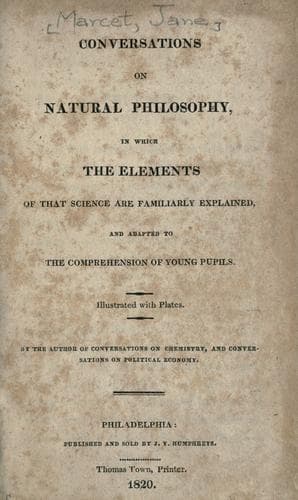
Conversations on Natural Philosophy, in which the Elements of that Science are Familiarly ExplainedMarcet, Mrs. (Jane Haldimand)
Science
Conversations on Natural Philosophy, in which the Elements of that Science are Familiarly Explained
Marcet, Mrs. (Jane Haldimand)
Physics
_Mrs. B._ They are the fixed stars; which the ancients, in order to
recognise them, formed into groups, and gave the names of the figures,
which you find delineated on the celestial globe. In order to show their
proper situations in the heavens, they should be painted on the internal
surface of a hollow sphere, from the centre of which you should view
them; you would then behold them as they appear to be situated in the
heavens. The twelve constellations, called the signs of the zodiac, are
those which are so situated, that the earth, in its annual revolution,
passes directly between them, and the sun. Their names are Aries,
Taurus, Gemini, Cancer, Leo, Virgo, Libra, Scorpio, Sagittarius,
Capricornus, Aquarius, Pisces; the whole occupying a complete circle, or
broad belt, in the heavens, called the zodiac. (plate 8. fig. 1.) Hence,
a right line drawn from the earth, and passing through the sun, would
reach one of these constellations, and the sun is said to be in that
constellation at which the line terminates: thus, when the earth is at
A, the sun would appear to be in the constellation or sign Aries; when
the earth is at B, the sun would appear in Cancer; when the earth was at
C, the sun would be in Libra; and when the earth was at D, the sun would
be in Capricorn. You are aware that it is the real motion of the earth
in its orbit, which gives to the sun this apparent motion through the
signs. This circle, in which the sun thus appears to move, and which
passes through the middle of the zodiac, is called the ecliptic.
_Caroline._ But many of the stars in these constellations appear beyond
the zodiac.
[Illustration: PLATE VIII.]
_Mrs. B._ We have no means of ascertaining the distance of the fixed
stars. When, therefore, they are said to be in the zodiac, it is merely
implied that they are situated in that direction, and that they shine
upon us through that portion of the heavens, which we call the zodiac.
_Emily._ But are not those large bright stars, which are called stars of
the first magnitude, nearer to us, than those small ones which we can
scarcely discern?
_Mrs. B._ It may be so; or the difference of size and brilliancy of the
stars may proceed from their difference of dimensions; this is a point
which astronomers are not enabled to determine. Considering them as
suns, I see no reason why different suns should not vary in dimensions,
as well as the planets belonging to them.
_Emily._ What a wonderful and beautiful system this is, and how
astonishing to think that every fixed star may probably be attended by a
similar train of planets!
Public-domain text, read in full here on John Shaqi.
Reviews
Reviews
No reviews yet
Be the first to share your thoughts on this work.
Elsewhere in the archive
Join the Discussion
Join the discussion
Sign in to leave a comment or review.
Sign InorCreate an account