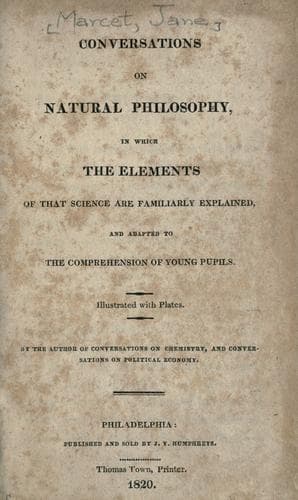
Conversations on Natural Philosophy, in which the Elements of that Science are Familiarly ExplainedMarcet, Mrs. (Jane Haldimand)
Science
Conversations on Natural Philosophy, in which the Elements of that Science are Familiarly Explained
Marcet, Mrs. (Jane Haldimand)
Physics
_Caroline._ You will accuse me of being very incredulous, but I cannot
help still entertaining some doubts, and fearing that there is more
beauty than truth in this system. It certainly may be so; but there does
not appear to me to be sufficient evidence to prove it. It seems so
plain and obvious that the earth is motionless, and that the sun and
stars revolve round it;--your solar system, you must allow, is directly
in opposition to the evidence of our senses.
_Mrs. B._ Our senses so often mislead us, that we should not place
implicit reliance upon them.
_Caroline._ On what then can we rely, for do we not receive all our
ideas through the medium of our senses?
_Mrs. B._ It is true that they are our primary source of knowledge; but
the mind has the power of reflecting, judging, and deciding upon the
ideas received by the organs of sense. This faculty, which we call
reason, has frequently proved to us, that our senses are liable to err.
If you have ever sailed on the water, with a very steady breeze, you
must have seen the houses, trees, and every object on the shore move,
while you were sailing.
_Caroline._ I remember thinking so, when I was very young; but I now
know that their motion is only apparent. It is true that my reason, in
this case, corrects the error of my sight.
_Mrs. B._ It teaches you, that the apparent motion of the objects on
shore, proceeds from your being yourself moving, and that you are not
sensible of your own motion, because you meet with no resistance. It is
only when some obstacle impedes our motion, that we are conscious of
moving; and if you were to close your eyes when you were sailing on
calm water, with a steady wind, you would not perceive that you moved,
for you could not feel it, and you could see it only by observing the
change of place of the objects on shore. So it is with the motion of the
earth: every thing on its surface, and the air that surrounds it,
accompanies it in its revolution; it meets with no resistance:
therefore, like the crew of a vessel sailing with a fair wind, in a calm
sea, we are insensible of our motion.
_Caroline._ But the principal reason why the crew of a vessel in a calm
sea do not perceive their motion, is, because they move exceedingly
slow, while the earth, you say, revolves with great velocity.
_Mrs. B._ It is not because they move slowly, but because they move
steadily, and meet with no irregular resistances, that the crew of a
vessel do not perceive their motion; for they would be equally
insensible to it, with the strongest wind, provided it were steady, that
they sailed with it, and that it did not agitate the water; but this
last condition, you know, is not possible, for the wind will always
produce waves which offer more or less resistance to the vessel, and
then the motion becomes sensible, because it is unequal.
Public-domain text, read in full here on John Shaqi.
Reviews
Reviews
No reviews yet
Be the first to share your thoughts on this work.
Elsewhere in the archive
Join the Discussion
Join the discussion
Sign in to leave a comment or review.
Sign InorCreate an account