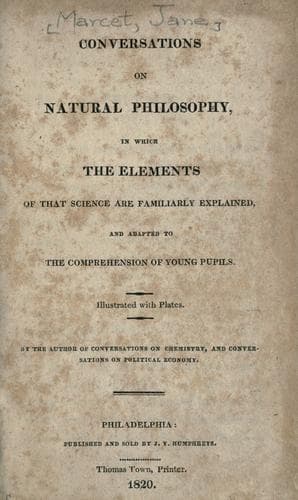
Conversations on Natural Philosophy, in which the Elements of that Science are Familiarly ExplainedMarcet, Mrs. (Jane Haldimand)
Science
Conversations on Natural Philosophy, in which the Elements of that Science are Familiarly Explained
Marcet, Mrs. (Jane Haldimand)
Physics
_Caroline._ But, granting this, the crew of a vessel have a proof of
their motion, which the inhabitants of the earth cannot have,--the
apparent motion of the objects on shore, or their having passed from one
place to another.
_Mrs. B._ Have we not a similar proof of the earth's motion, in the
apparent motion of the sun and stars? Imagine the earth to be sailing
round its axis, and successively passing by every star, which, like the
objects on land, we suppose to be moving instead of ourselves. I have
heard it observed by an ærial traveller in a balloon, that the earth
appears to sink beneath the balloon, instead of the balloon rising above
the earth.
It is a law which we discover throughout nature, and worthy of its great
Author, that all its purposes are accomplished by the most simple means;
and what reason have we to suppose this law infringed, in order that we
may remain at rest, while the sun and stars move round us; their regular
motions, which are explained by the laws of attraction, on the first
supposition, would be unintelligible on the last, and the order and
harmony of the universe be destroyed. Think what an immense circuit the
sun and stars would make daily, were their apparent motions, real. We
know many of them, to be bodies more considerable than our earth; for
our eyes vainly endeavour to persuade us, that they are little
brilliants sparkling in the heavens; while science teaches us that they
are immense spheres, whose apparent dimensions are diminished by
distance. Why then should these enormous globes daily traverse such a
prodigious space, merely to prevent the necessity of our earth's
revolving on its axis?
_Caroline._ I think I must now be convinced. But you will, I hope, allow
me a little time to familiarise to myself, an idea so different from
that which I have been accustomed to entertain. And pray, at what rate
do we move?
_Mrs. B._ The motion produced by the revolution of the earth on its
axis, is about seventeen miles a minute, to an inhabitant on the
equator.
_Emily._ But does not every part of the earth move with the same
velocity?
_Mrs. B._ A moment's reflection would convince you of the contrary: a
person at the equator must move quicker than one situated near the
poles, since they both perform a revolution in 24 hours.
_Emily._ True, the equator is farthest from the axis of motion. But in
the earth's revolution round the sun, every part must move with equal
velocity?
_Mrs. B._ Yes, about a thousand miles a minute.
_Caroline._ How astonishing!--and that it should be possible for us to
be insensible of such a rapid motion. You would not tell me this sooner,
Mrs. B., for fear of increasing my incredulity.
Before the time of Newton, was not the earth supposed to be in the
centre of the system, and the sun, moon, and stars to revolve round it?
Public-domain text, read in full here on John Shaqi.
Reviews
Reviews
No reviews yet
Be the first to share your thoughts on this work.
Elsewhere in the archive
Join the Discussion
Join the discussion
Sign in to leave a comment or review.
Sign InorCreate an account