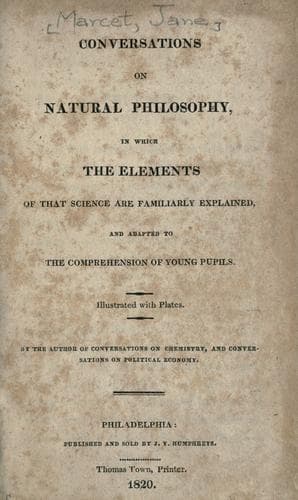
Conversations on Natural Philosophy, in which the Elements of that Science are Familiarly ExplainedMarcet, Mrs. (Jane Haldimand)
Science
Conversations on Natural Philosophy, in which the Elements of that Science are Familiarly Explained
Marcet, Mrs. (Jane Haldimand)
Physics
_Mrs. B._ You know that the revolution of the earth on its axis, must
give to every particle a tendency to fly off from the centre, that this
tendency is stronger, or weaker, in proportion to the velocity with
which the particle moves; now a particle situated near to one of the
poles, makes one rotation in the same space of time as a particle at the
equator; the latter, therefore, having a much larger circle to describe,
travels proportionally faster, consequently the centrifugal force is
much stronger at the equator than in the polar regions: it gradually
decreases as you leave the equator and approach the poles, at which
points the centrifugal force, entirely ceases. Supposing, therefore, the
earth to have been originally in a fluid state, the particles in the
torrid zone would recede much farther from the centre than those in the
frigid zones; thus the polar regions would become flattened, and those
about the equator elevated.
As a large portion of the earth is covered with water, the Creator gave
to it the form, denominated an _oblate spheroid_, otherwise the polar
regions would have been without water, and those about the equator,
would have been buried several miles below the surface of the ocean.
_Caroline._ I did not consider that the particles in the neighbourhood
of the equator, move with greater velocity than those about the poles;
this was the reason I could not understand you.
_Mrs. B._ You must be careful to remember, that those parts of a body
which are farthest from the centre of motion, must move with the
greatest velocity: the axis of the earth is the centre of its diurnal
motion, and the equatorial regions the parts most distant from the axis.
_Caroline._ My head then moves faster than my feet; and upon the summit
of a mountain, we are carried round quicker than in a valley?
_Mrs. B._ Certainly; your head is more distant from the centre of motion
than your feet; the mountain-top than the valley; and the more distant
any part of a body is from the centre of motion, the larger is the
circle it will describe, and the greater therefore must be its velocity.
_Emily._ I have been reflecting, that if the earth is not a perfect
circle----
_Mrs. B._ A sphere you mean, my dear: a circle is a round line, every
part of which is equally distant from the centre; a sphere or globe is a
round body, the surface of which is every where equally distant from the
centre.
_Emily._ If, then, the earth is not a perfect sphere, but prominent at
the equator, and depressed at the poles, would not a body weigh heavier
at the equator than at the poles? For the earth being thicker at the
equator, the attraction of gravity perpendicularly downwards must be
stronger.
Public-domain text, read in full here on John Shaqi.
Reviews
Reviews
No reviews yet
Be the first to share your thoughts on this work.
Elsewhere in the archive
Join the Discussion
Join the discussion
Sign in to leave a comment or review.
Sign InorCreate an account