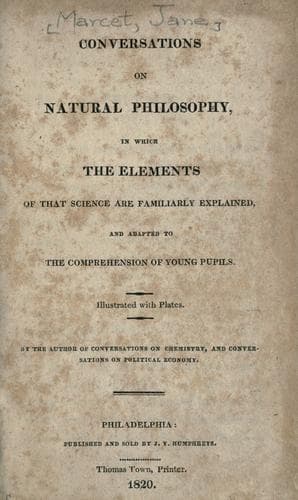
Conversations on Natural Philosophy, in which the Elements of that Science are Familiarly ExplainedMarcet, Mrs. (Jane Haldimand)
Science
Conversations on Natural Philosophy, in which the Elements of that Science are Familiarly Explained
Marcet, Mrs. (Jane Haldimand)
Physics
_Mrs. B._ Your reasoning has some plausibility, but I am sorry to be
obliged to add, that it is quite erroneous; for the nearer any part of
the surface of a body is to the centre of attraction, the more strongly
it is attracted; because it is then nearest to the whole mass of
attracting matter. In regard to its effects, you might consider the
whole power of gravity, as placed at the centre of attraction.
_Emily._ But were you to penetrate deep into the earth, would gravity
increase as you approached the centre?
_Mrs. B._ Certainly not; I am referring only to any situation on the
surface of the earth. Were you to penetrate into the interior, the
attraction of the parts above you, would counteract that of the parts
beneath you, and consequently diminish the power of gravity in
proportion as you approach the centre; and if you reached that point,
being equally attracted by the parts all around you, the effects of
gravity would cease, and you would be without weight.
_Emily._ Bodies, then, should weigh less at the equator than at the
poles, since they are more distant from the centre of gravity in the
former than in the latter situation?
_Mrs. B._ And this is really the case; but the difference of weight
would be scarcely sensible, were it not augmented by another
circumstance.
_Caroline._ And what is this singular circumstance, which seems to
disturb the laws of nature?
_Mrs. B._ One that you are well acquainted with, as conducing more to
the preservation than the destruction of order,--the centrifugal force.
This we have just observed to be strongest at the equator; and as it
tends to drive bodies from the centre, it is necessarily opposed to, and
must lessen the power of gravity, which attracts them towards the
centre. We accordingly find that bodies weigh lightest at the equator,
where the centrifugal force is greatest; and heaviest at the poles,
where this power is least: the weight being diminished at the equator,
by both the causes mentioned.
_Caroline._ Has the experiment been made in these different situations?
_Mrs. B._ Louis XIV. of France, sent philosophers both to the equator,
and to Lapland, for this purpose: the severity of the climate, and
obstruction from the ice, have hitherto rendered every attempt to reach
the pole abortive; but the difference of gravity at the equator, and in
Lapland is very perceptible.
_Caroline._ Yet I do not comprehend how the difference of weight could
be ascertained, for if the body under trial decreased in weight, the
weight which was opposed to it in the opposite scale must have
diminished in the same proportion. For instance, if a pound of sugar did
not weigh so heavy at the equator as at the poles, the leaden pound
which served to weigh it, would not be so heavy either; therefore they
would still balance each other, and the different force of gravity could
not be ascertained by this means.
Public-domain text, read in full here on John Shaqi.
Reviews
Reviews
No reviews yet
Be the first to share your thoughts on this work.
Elsewhere in the archive
Join the Discussion
Join the discussion
Sign in to leave a comment or review.
Sign InorCreate an account